Friday, October 26, 2012

Zrze is not the same as Žurče: October 25, 2012

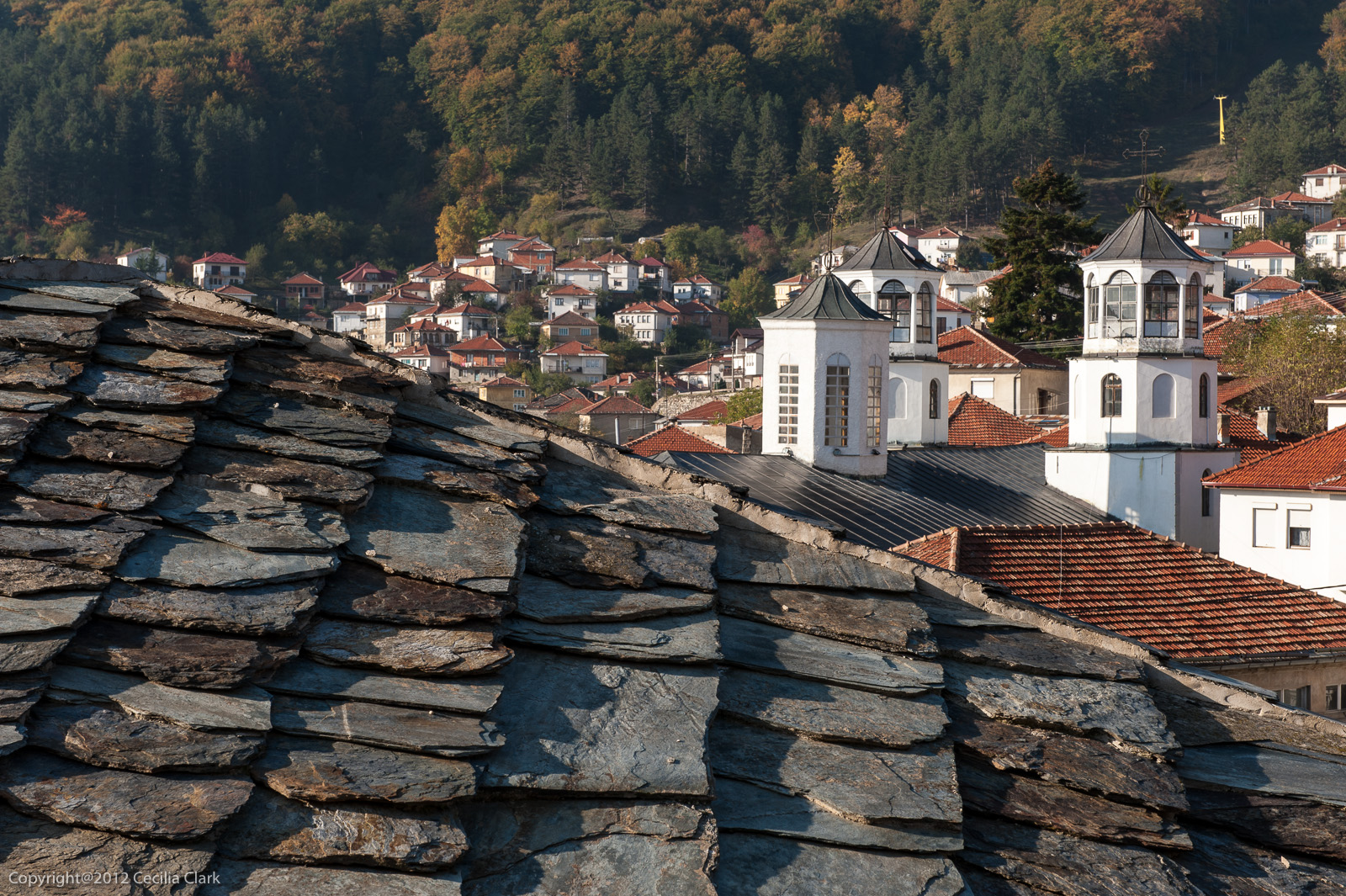
Leaving Kruševo behind, we went to the nearby village of Žurče to see a Monastery.  I thought this was the village of Zrze the former home of the unusual icon called the Virgin of Pelagonia, but Zrze is not the same as Žurče.  In Žurče we visited the monastery dedicated to Sveti Atanas Aleksandriski.  A young sister-in-training named Christina was our greeter.  She opened the door to the church and explained both the interior and exterior frescos.  Then, she gave us a tour of the grounds.


Monastery dedicated to Sveti Atanas Aleksandriski in Žurče

This monastery has been around since at least the 12th century, but the current construction of the church and the frescos date to the early 17th century.  The frescos are lovely and unusual.  The frescos on the open porch area include naturalistic paintings of life during the months of the year.  They illustrate hunting, harvest, sunbathing (while being cooled by a peasant), etc.  Unfortunately photographs are only allowed if taken from a distance.

The sisters and sisters-in-training of this monastery raise chickens, goats, sheep, and they also had some black deer (one buck, two does, and a fawn) in pens.  The buck was very friendly, but the females and fawn were skittish.


In an attempt to be self sufficient, the sisters make and sell their own cheese and a rich, dark honey.  They have fruit-tree orchards and a greenhouse for vegetables.

Christina invited us to have lunch with her.  The table was set with pears, their cheese from goat's milk, a spinach-buttery bread.  While we were eating, we were surrounded by hungry cats who Christina said must work for a living.  She said they only feed the kittens, but they sure acted like cats who were used to being fed by humans.


Christina showed us on a map where Zrze is located (north-west of Prilep), but that will be another trip.

The village of Žurče is as neat as a pin with many stone structures.  Tobacco was drying everywhere as were peppers.  We chatted with a Macedonian who had worked for many years in Australia.  Now retired, he had returned to live and enjoy his life in Žurče.


On the way back to Skopje, we stopped once again at the tobacco drying structures in Prilep.  While I was taking photographs, Dan napped and I chatted with a tobacco grower named Branko.


Branko said he will get between 2 to 4 Euros per kilo for his tobacco.  The price is based upon the quality of the leaves.  He told me that depending upon the amount of sun, the green leaves take between 7 to 10 days to become golden and dry.


So, now I know even more about growing and selling tobacco.  The end.


Wednesday, October 24, 2012

Kruševo: October 23-25, 2012


Autumn at Kruševo Lake

Tuesday was The Day of the Macedonian Revolutionary Struggle; it was also a holiday and a good time to see more of Macedonia.  On this day in 1893 the Internal Macedonian Revolutionary Organization (IMRO) was established with the purpose of liberating Macedonia from the Ottoman Empire.  Today, this revolutionary movement has devolved into a right-wing political party (the party in power) known as VMRO.  

Kruševo was the scene of an early 20th-century struggle against the Ottomans. The Ilinden Uprising began on August 2, 1903 (St. Ilija's Day and "Den" means "day" in Macedonian).  On August 3, 1903, rebels took the town of Kruševo and established a revolutionary government. The Krusevo Republic lasted just 10 days, but left a huge legacy in the struggle for Macedonian independence.  

There are several monuments to commemorate the struggle for independence from the Ottoman Empire.  A guide at the monument explained some of the parts and their metaphorical meaning.  First, there are three links that symbolize the links in the chain that represent three centuries (15th-17th) under Ottoman rule.  Then, there are two broken chains laying nearby that symbolize the attempt to break free in the 18th & 19th-centuries. 


Moving up the hill beyond the trees is the monument for the 20th-century Ilinden Uprising and the 10 days Kruševo was a republic with a president.  The tomb of this president, Nikola Karaev, is within this monument.  The eternal flame, however, is out.


The Ilinden Monument, installed in the 70s, looks very much like an artist's conception of a space ship.  It is supposed to be in the shape of the heavy club weapon called a mace.


Kruševo the place to be on the August 2 holiday and that is date when this "ethno" village really comes alive.  Kruševo was very quiet during our two days in October, but it has my vote for the friendliest town in Macedonia.  Everyone was extraordinarily friendly toward us, and they seemed pleased that we wanted to photograph them and their beautiful town.  

Kruševo, with an elevation of 1260 meters, is the highest town in the Balkans.  The autumn weather was crisp and cool in the mornings and evenings, and the smell of wood smoke and grilling peppers filled the air.

We stayed at the Casa La Kola B&B because back in February we purchased a weekend stay in Kruševo at a charity auction.  Casa La Kola was very pleasant and comfortable and in the center of town; we parked in front and walked everywhere.  The hotel recommended Roma Pizza Restaurant on the main street as the best place in town to eat.  We ate both dinners there, and it was really good with local specialties like the "Roma" bake.

View of Kruševo from a southern hill

Traditional architecture in Kruševo

The guide at the Ilinden Uprising monument told us the Gallery Nikola Martinoski was open.  This interesting gallery is in one of the houses of traditional architecture similar to the ones shown above.  Martinoski was a painter, trained in Paris, who donated many of his fine works to Kruševo. The gallery also has several ethnographic rooms dedicated to early life in Kruševo.

View of Sveti Jovan from our balcony at Casa La Kola


A Cooper at the Barrel-making Shop in the Old Bazaar 

Near the monument to the Ilinden Uprising is the Todor Proeski Memorial House.  Todor known popularly as Toše was from Kruševo.  In 2007 at 26 years old, he was killed in a car accident in Croatia.  He was a singer who was very popular in the Balkans.  I've heard him described as the Macedonian Elvis Presley in his popularity.  The guide at the memorial house told us he was the best singer in all the world.  The memorial house preserves everything from Toše' life.  His toys, his sports equipment, his guitars, his clothing, his furnishings.  Words to his songs are etched in glass throughout the memorial house.  Also nearby is his grave covered by a tent that is filled with gifts left by fans that miss him and remember him.


Kruševo Lake is just beyond the Toše memorial house.  The lake is small with a walking/bike trail around the perimeter.  Many small fields of tobacco lay just across the bridge over the small dam that created the lake.  One of the tobacco farmers invited us onto his land to see the process of picking, stringing, and drying tobacco leaves.  He has two deci-hectars of land on which he grows tobacco.  He said he grows a first class tobacco that will net him 4 Euro per kilo, and he will harvest and dry more than 400 kilos of tobacco this season.  


A Field of Tobacco

Our last morning we returned to the lake because it was so lovely and photogenic.


Saturday, October 20, 2012

Autumn: October 20, 2012


The season has changed.  The long, hot summer is gone and there is a crispness to the morning and evening air.  The swallows of summer have flown on and the crows have returned.  October 15 is the date that Skopje's central heating system begins working.  It was on for that one cool day, but now the days are so warm that it is off again.


And like the returning crows, no actual comparison intended, the women of IWA have returned from their summer vacations.  I've joined a cooking group which met for the first time last Thursday, and Monday hikes are back.  

The smell of roasted corn on the cob has been replaced by the aroma of roasting chestnuts.  Our summer clothes are packed into a suitcase because the next time we need them we will be in California. The new Skopje City Mall with a Carrefour store opened about three weeks ago and is attracting hordes of shoppers.  Friday evening was the start of the Skopje Jazz Festival 2012.

The building and statue boom initiated by the Skopje 2014 plan continues with new building construction and the installation of new statues while older statues and buildings are neglected.  More dirt has been dumped into the River Vardar in the government's continued effort to make Skopje the ugliest city in the world albeit with the most statues.  

Ministry of Foreign Affairs (in foreground) with a new pile of dirt

The uncompleted "Art" Bridge to the new Financial Police Building

 The unfinished Archaeological Museum of Macedonia with the also unfinished "History" Bridge


A portion of the green area near our building has just been cleared, and now it is surrounded by a construction fence.  A10-story city administration building will be built.  The sidewalk and lighting have been removed, but so far, the fish remains.  A baroque-style 6-story parking garage will be built over the present asphalt parking lot in front of our building. There are so few green spaces in Skopje, and next year there will be even less.

How much will the Skopje 2014 project cost?  In 2009, the government of Macedonia announced Skopje 2014 and its 80-million-euro-price tag.  According to an investigative article in the Pristina Insight newspaper, there have been many addendums to initial contracts (some of which are now missing) bringing the current expenditure to about 200-million euros. The opposition party claims the new price tag is over 350-million euro.

Thursday, October 11, 2012

Ajvar Season in Macedonia: October 11, 2012

Today is a holiday; it is "People's Uprising Against Fascism Day."  This holiday caught us off guard with no plan on how to spend this day off.  After looking through our guidebook, we decided to take a taxi to Šuto Orizari.  Šuto Orizari or "Šuto" most people know it, is a Roma community.  There is a very large clothing market there that sells items at very low prices, but it is also a neighborhood. 

We walked along the main street passing the market by.  Eventually, we turned into the neighborhood.  The neighborhood is sprinkled with large homes that have been built by those families who have members working abroad.  These houses project wealth and success and returned remittances.  Between these mansion-like homes are much smaller, modest homes.  As we walked, we let our noses set the direction. The delicious smell of roasting peppers on this cool day perfumed the air.    

Autumn is the season of ajvar in Macedonia.  Ajvar is eaten all year long and it is its own food group in Macedonia.  It is served with meats and with white feta-like cheese.  It is used as a spread on thick slices of bread. 

At our first stop, we found peppers cooking on a metal platform over a wood fire.  The lady of the house vigilantly turned the peppers.  Once a batch of peppers are evenly grilled and the skins blistered, they are scooped into a plastic bag to sweat the skin of the peppers.  Once sweated, a group of family members begins the tedious work of separating the skin from the pepper.


After we watched for a while, this family directed us down and across the street to another ajvar-making group.  This was a larger group of friends and family peeling and seeding peppers.  In their recipe, they also add peeled tomatoes.  Some recipes include eggplant, as well. 


We did not stay long enough to observe the rest of the process. Ajvar is usually a two-day process.   Once the peppers are peeled, they are minced.  Because of the intensive hand work involved, this step is often mechanized with the use of a grinder to reduce the peppers to a mince.  A large, cauldron-like pot is placed over a wood fire and once oil covering the bottom of the pot is hot, the peppers and other ingredients are added.  As the peppers cook, the pot is stirred continually to keep the contents from burning.  Once cooked, ajvar is preserved in jars to be consumed all winter long, and there should be enough to last until the next ajvar season.

Here is an ingredient list from Macedonian Traditional Cookbook:

60 kilos red peppers (ajvar peppers)
10 kilos of eggplants
3.5 liters of oil
100 grams of sugar
salt to taste

Makes about 23 jars of ajvar

We enjoyed ourselves and I hope the Romas we met enjoyed meeting two Americans roaming their neighborhood and interested in how they live.  We caught a bus back to Skopje's center.

That was how we spent our "Uprising against Fascism" holiday.  The commemoration is for October 11, 1941; the day "the people of Macedonia began to organize and mount an armed insurrection against their Bulgarian and Italian occupiers with an attack on the local Axis-power headquarters in the city of Prilep...., Partisans staged a simultaneous uprising against the fascists in the city of Kumanovo. The October 11 rebellion launched the war for liberation from fascist occupation, which coincided with the rise of the communist movement in Macedonia."

Macedonian TV (MTB) station has a short YouTube MTB video giving the Macedonian version of the events of October 11, 1941.  The comments for this video have been disabled.  Why?  I'm guessing that not everyone agrees with this version of events.

Sunday, October 7, 2012

Weekend in Bitola and Prilep: October 4-7, 2012

We found ourselves in Bitola for the weekend because Dan was teaching a class of Macedonian lawyers. Bitola is lovely with many structures from the 18th, 19th, and early 20th-centuries.  Some say that if not for the massive earthquake in 1963, Skopje would look like this.  Anyway, the buildings along the pedestrian street are well preserved and give Bitola a quality and charm that is missing elsewhere in Macedonia.  


Bitola, like most cities in Macedonia, has an old Turkish town and bazaar dating back to the time when Macedonia was part of the larger Ottoman Macedonia.  


Pre-Balkan wars and WWII, Bitola was a flourishing city accommodating many religions within the small area of the present-day pedestrian street.  Then there were several mosques and a synagogue in the older, Turkish area and a catholic church, an orthodox church across the River Dragor in the 18th-century city. Today, the synagogue is gone as are the Jews.  A decade ago the Ottoman-era clock tower was topped with a cross.  In former times, Muslim imams looked to the time on the clock tower to guide their calls to prayer. Today, most of the mosques are non-functioning, remnants of history.

Interior of the Catholic Church 

A corner in the Old Turkish Bazaar (little Montmartre) area of Bitola


Strangely, even though the residents of Bitola, and indeed all of Macedonia chaffed under the yoke of Ottoman rule, half of the Bitola museum is a shrine to Ataturk.  Mustafa Kemel spent some of his military school years in Bitola and present-day Bitola honors that brief stay with a room dedicated to all things Ataturk.

After exhausting Bitola's offerings, I visited the nearby city of Prilep to see the tobacco harvest.  Twenty-two percent of the value of agricultural exports from Macedonia is from tobacco, and almost one third of the Macedonian state budget is financed by tobacco work.  Macedonia is ranked 30th in world tobacco production.  Prilep produces several small-leaf oriental tobaccos  It is the spice or seasoning when mixed with Virginia broadleaf tobacco.  Prilep tobacco is found in most of the world's top selling brands.

August, September, and October are the months that the leaves are handpicked from the tobacco plants.  As the leaves mature, they are stripped by hand from the plants.  Once the mature leaves are gathered, they are strung onto a 2-meter string and hung on wooded frames.  Drying racks are in front of houses and on empty lots.  During the harvest season, they are everywhere there is space.


There are large empty lots that are covered with tented drying racks.  Each tented structure has a family name written on it.  As the leaves dry and become golden, those strings are removed and new strings of green leaves are strung in their places.  


As cigarette makers move toward lighter, lower nicotine-type cigarettes, demand for Macedonia's oriental tobacco is declining. The World Health Organization (WHO) is pushing for regulations that will decrease cigarette consumption and smoking.  Tobacco growers all over the Balkans are opposed to these regulations.  Tobacco has been grown in Macedonia for over 100 years and a decline in this industry will cause thousands of small farmers to lose their only source of income.
  

Tuesday, October 2, 2012

Justice Delayed is Justice Denied: October 2, 2012

Dan and ЈУСТИНИЈАН I

The day before we left for our Balkan vacation, I received a call from an expat friend of mine.  She told me that she was being expelled as she had overstayed her visa.  The day before she had gone to the airport to catch a flight to Vienna; at the airport, the Macedonian Immigration Officer counted the days that she had been in Macedonia.  As with me, her days in Macedonia far exceed the rule of no more than 90 days within a 180-day period.  She missed that flight, and after interrogating her for a couple of hours and many calls by her to people in authority, Macedonian Immigration expelled her from the country ordering her to leave the very next day.

Before her call, I had become complacent in my efforts to become a legal resident in Macedonia.  After many, many exits and entries with no one noticing the total days that I have been here, I believed it unlikely that anyone would ever notice.

For our Balkan vacation, we crossed the border from Macedonia into Albania with no problems.  We returned two weeks later crossing from Kosovo into Macedonia.  Again, no problems.  But, spurred into action by my friend's experience, last week I assembled all the documents and their translations as specified last time by the woman at the Ministry of Internal Affairs (MOI).  Friday, I went to the MOI.  I arrived at 12:30 pm and discovered that the office is open only from 9 am to 12:30 pm.  Today, I returned with Dan who wanted to inquire about an extension of his resident visa which expires on November 14, 2012.

The same MOI woman took my package of documents and looked at Dan's resident visa card.  She said I cannot apply for a card unless the term of Dan's resident card is for one year.  She said she told us about that requirement the last time we were in.  She did not!

So, it is a Catch-22 for us/me.  We have just 3 months left to be in Macedonia, I have overstayed my tourist visa by 6 months, and I cannot get a card.

Dan has issues because his INCOMPETENT Macedonian lawyer proceeded as if Dan was an employee working in Macedonia and earning a salary here.  Dan is a volunteer and while his living expenses are reimbursed, he receives no money in Macedonia.  The Department of Labor wanted him to submit information showing that health care insurance, taxes, etc were being withheld from a Macedonian salary.  Since he is not an employee, he couldn't comply with the document request.

Also, last week I met our landlady once again at the Police Station to register my presence in Macedonia.  Because I don't have a resident card, I must report to the Police Station with my landlady within 48 hours of entrance into Macedonia.  This time, the officer was very bureaucratic even checking in his prior book for my last registration.  He also informed me that I was in violation because I had not advised the Police that I was leaving Macedonia within 24 hours of my departure.  I have been here since January 12, and this is the first time anyone has advised me of this departure notice requirement.

September 8 was Independence Day in Macedonia.  A new statue complex, which includes an eternal flame, was opened for unidentified Macedonian Fallen Heros.  The first statue is of Prometheus.  Prometheus caused quite a bit of trouble initially because he was buck naked.  Citing a complaint from unspecified women's organizations, the government directed the artist to cover the offending body part.  Now Prometheus wears a golden diaper.


Behind Prometheus, is a doorway to eternity leading to the eternal flame and beyond to the winged goddess symbolizing victory.  In the middle portion of the complex is a second doorway topped by 4 golden horses.  Above the doorway are the Latin words for immortality, freedom and justice.  The words are etched into the marble.  That is unfortunate because the Latin word for justice,  JUSTITA, is misspelled "JUSTICA."  The artist should have stuck with Cyrillic lettering as used on the statue of Justinian.  In that case, although he would not have been able to read his own name, Macedonians can.


Tuesday, September 25, 2012

A Balkan Vacation: September 12-24, 2012


With Dan freed from teaching Macedonian lawyers for a couple of weeks, we took a road trip through some of Macedonia's Balkan neighbors.  I don't like "road trips".   There is way too much driving and too little being in one place.  This dislike was etched in my mind when I was a child.  Bi-annually, my parents would pile all of us kids (first 3 kids and later 5 kids) into a car and drive as fast as possible from California to either Georgia or South Dakota.  One year we made a large circle to hit both Georgia and South Dakota.  My father did not understand the concept of "enjoying the journey."  We drove though national parks and historic landmarks and didn't stop.  For him only the destination was important.  Consequently, during the two to four-day journey portion of the road trip, the car was a miserable, tear filled, boring place to be for 18 hours each day.

Dan and I disagreed about whether or not we should make reservations for this two-week vacation.  I didn't think it was necessary because it was already middle September.  Dan insisted it was necessary so we reached a compromise.  Dan reserved rooms for the first several nights and after that we would go wherever we were drawn.

Our first stop was Tirana, Albania.  Upon arriving at the hotel, we were told that our reservation was for the previous night, but fortunately for us they did happen to have a room for us on this night.  Tirana's city center was full of restaurants and great looking shops.  We stayed one night here just to break up our trip to the coast.  Before we left Tirana the next morning, we took a short walk around to view some of the more popular sites.  The above photo is what remains of the former Enver Hoxha Museum.  After President Hoxha and communism in Albania died, the building, called The Pyramid, was converted to a Cultural Center.  The structure which has fallen into disuse and disrepair is now just a canvas for graffiti.

The History Museum with a great Communist-era Mosaic


The central oval is encircled by early 20th-century lovely Italian-built government buildings.  The center statue is Albanian hero Skanderbeg (Albanian for Alexander-same name, but not the same Alexander).  At the hotel's suggestion, on the way to Montenegro we stopped briefly at the Albanian town of Shkoder.  Shkoder has an attractive pedestrian street lined with cafes and anchored at one end by a mosque.  It didn't seem to offer any other interesting sights as we drove through the remainder of the city.

Shkoder's Pedestrian Street

Our second and third nights were to be in Kotor, Montenegro.  Along the way we stopped at the pretty Montenegrin coastal town of Sveti Stefan.   The town has a peninsula that before the breakup of Yugoslavia was once filled with the rich and famous.  It may be returning to that status because Dan and I thought we could walk over the causeway to the peninsula, but were prevented by a security guard who told us it was "private."  We resigned ourselves to taking photos from the beach.  The weather was rapidly changing and the sea was soon a dramatic froth.  

View of Sveti Stefan

By the time we arrived in Kotor, it was raining--hard.  There we learned that our two-night reservation in Kotor began the previous night.  Because we hadn't shown up the night before, they decided to rent our room for this night to someone else.  We found another hotel and cut our stay in Kotor to one night which made us current on the next reservation.  We tried to explore Kotor the first evening, but the streets were like rivers and soon our feet were soaked.  The next morning, we again tried to explore Kotor, but the continuing rain dampened our spirits and our shoes.  All this was adding up to a very inauspicious start to our Balkan road trip.

With wet shoes, we drove to Dubrovnik, Croatia.  Dubrovnik is beautiful but oh so sterile.  It is the landside-theme park for cruise ship passengers.  During the high season which does not end until mid November, as many as 7,000 cruise ship passengers squeeze through the old city walls of Dubrovnik.  Few local people live in the old city because it is expensive.  It is a place of souvenir shops, not very good restaurants, clusters of tour groups, and museums.    

View of Dubrovnik's Old City


Our second and third days in Dubrovnik the weather was warm, clear, and beautiful.  Dan and I visited every museum, cathedral, church in the old city. 


We walked the old city walls in the late afternoon and the views were like no other place.  


The end of our stay in Dubrovnik was also the end of our advance reservations.  While in Dubrovnik, we searched hotel sites looking for a hotel somewhere for the next night.  Finally, we found a room for one night only in Korčula on Korčula Island.  At this point, we are not traveling to where our hearts lead us but to where we can find a room.  It's Dan's turn to say, "I told you so."

Korčula is beautiful and would have been so nice if we could have stayed there for 3-4 days.  There is wine tasting, kayaking, swimming in small coves--everything for a peaceful vacation.  But, the next morning, we drove to the other end of the island and took a ferry to Split.  The day was warm and both of us darkened our tans sitting topside on the ferry.  Dan napped and I read.

Of the walled cities we visited, Split is my favorite.  The walled city is occupied by people who live there.  There are more than just tourist restaurants and shops. It is a living city. We stayed in an apartment within Diocletian's (maker of early Christian martyrs everywhere) palace.  Ironically, the center of his palace became a Christian church after Diocletian's death.  We walked everywhere.  


In Dubrovnik we first admired sculptures by the late, great Croatian artist, Ivan Meštrović.  In Split, his home is now a museum dedicated to his prolific life.  We visited the church, Kaštelet Chapel, he built on his property.  Below is a photo of the chapel and the crucifix Meštrović carved.  The right photo is Meštrović's angry sculpture of Bishop Gregory of Nin.  There is a tradition that if you rub the bishop's toe and make a wish, it will come true.  Consequently his big toe is very polished and shiny.

 Ivan Meštrović sculptures  

From Split, we drove inland to Croatia's beautiful Plitvice Lakes National Park.  This was the first national park in the former Yugoslavia.  This is also where the first shot was fired in the war between the Serbs and Croats.

Arriving in this beautiful forest with so many with lakes filled me with calm.  We set off down this path for a short walk.  While I was waiting for the sun to emerge from behind the clouds, I saw a woman that looked like someone I knew.  I quietly said her name, but she didn't respond.  At the next waterfall stop, she approached me and it was my friend Penny from my yoga class in Placerville, California.  She and her husband had decided to take a vacation to Croatia and to Italy.  This was their second night in Croatia (they did not have reservations either), and they had come to the park for one night.  Finally, an auspicious sign for our road trip.  Penny and John and Dan and I had dinner together that night.  It was so wonderful to meet by chance a friend that I've known for so long in a place neither of us knew we would be.


Penny and John stayed for one night and we stayed for two.  Dan and I walked almost all the trails enjoying this jewel of a park immensely.  The water is so clear that the fish are visible from above.  As a result, it is a good thing fishing is illegal here.


Leaving Plitvice Lake National Park behind we drove to Zagreb for one night and then into Serbia to overnight near Studenica Monastery.  The last time we were in Belgrade, we saw a museum exhibit about Studenica.  The museum reproductions of frescos and stonework were so fabulous we wanted to see the originals.  Unfortunately, the actual monastery is being renovated and the 12th-century frescos are being repaired.  The visit to the actual site was a bit of a let down.  We also stopped at the Smederovo fortress.  The fortress is largely in ruins due to an ammunition explosion and a later bombing during WWII, but the area within the ruined walls was park like and full of people exercising and enjoying the warm afternoon sun.   


The fortress was built in a strategic position on the Danube.  Just outside the walls, residents were fishing along the banks of the Danube or in small boats.  


The last day of our road trip was spent driving.  We left Serbia and soon entered the still contested northern area of Kosovo.  It was quite eerie driving into Kosovo from Serbia.  For quite a distance into Kosovo on the slow road to Mitrovica there were frequent groups of Serbian nationals sitting inside large storage containers situated next to the road.  The storage containers were decorated with Serbian flags.  Eventually, the groups of men changed to Kosovars with Albanian flags decorating their storage containers.  KFOR troops will be here for a long time.  Finally in Pristina, we had lunch and went in search of "Bill" so Dan could take a photograph of him.  

Once we left Pristina, we didn't stop until we got back to Skopje.  It is good to be back in our temporary home and it will be a long time before I submit/commit to another road trip.

More photos are on Flickr.
Croatia
Montenegro