
Autumn at Kruševo Lake
Tuesday was The Day of the Macedonian Revolutionary Struggle; it was also a holiday and a good time to see more of Macedonia. On this day in 1893 the Internal Macedonian Revolutionary Organization (IMRO) was established with the purpose of liberating Macedonia from the Ottoman Empire. Today, this revolutionary movement has devolved into a right-wing political party (the party in power) known as VMRO.
Kruševo was the scene of an early 20th-century struggle against the Ottomans. The Ilinden Uprising began on August 2, 1903 (St. Ilija's Day and "Den" means "day" in Macedonian). On August 3, 1903, rebels took the town of Kruševo and established a revolutionary government. The Krusevo Republic lasted just 10 days, but left a huge legacy in the struggle for Macedonian independence.
There are several monuments to commemorate the struggle for independence from the Ottoman Empire. A guide at the monument explained some of the parts and their metaphorical meaning. First, there are three links that symbolize the links in the chain that represent three centuries (15th-17th) under Ottoman rule. Then, there are two broken chains laying nearby that symbolize the attempt to break free in the 18th & 19th-centuries.

Moving up the hill beyond the trees is the monument for the 20th-century Ilinden Uprising and the 10 days Kruševo was a republic with a president. The tomb of this president, Nikola Karaev, is within this monument. The eternal flame, however, is out.

The Ilinden Monument, installed in the 70s, looks very much like an artist's conception of a space ship. It is supposed to be in the shape of the heavy club weapon called a mace.


Kruševo the place to be on the August 2 holiday and that is date when this "ethno" village really comes alive. Kruševo was very quiet during our two days in October, but it has my vote for the friendliest town in Macedonia. Everyone was extraordinarily friendly toward us, and they seemed pleased that we wanted to photograph them and their beautiful town.
Kruševo, with an elevation of 1260 meters, is the highest town in the Balkans. The autumn weather was crisp and cool in the mornings and evenings, and the smell of wood smoke and grilling peppers filled the air.
We stayed at the Casa La Kola B&B because back in February we purchased a weekend stay in Kruševo at a charity auction. Casa La Kola was very pleasant and comfortable and in the center of town; we parked in front and walked everywhere. The hotel recommended Roma Pizza Restaurant on the main street as the best place in town to eat. We ate both dinners there, and it was really good with local specialties like the "Roma" bake.

View of Kruševo from a southern hill


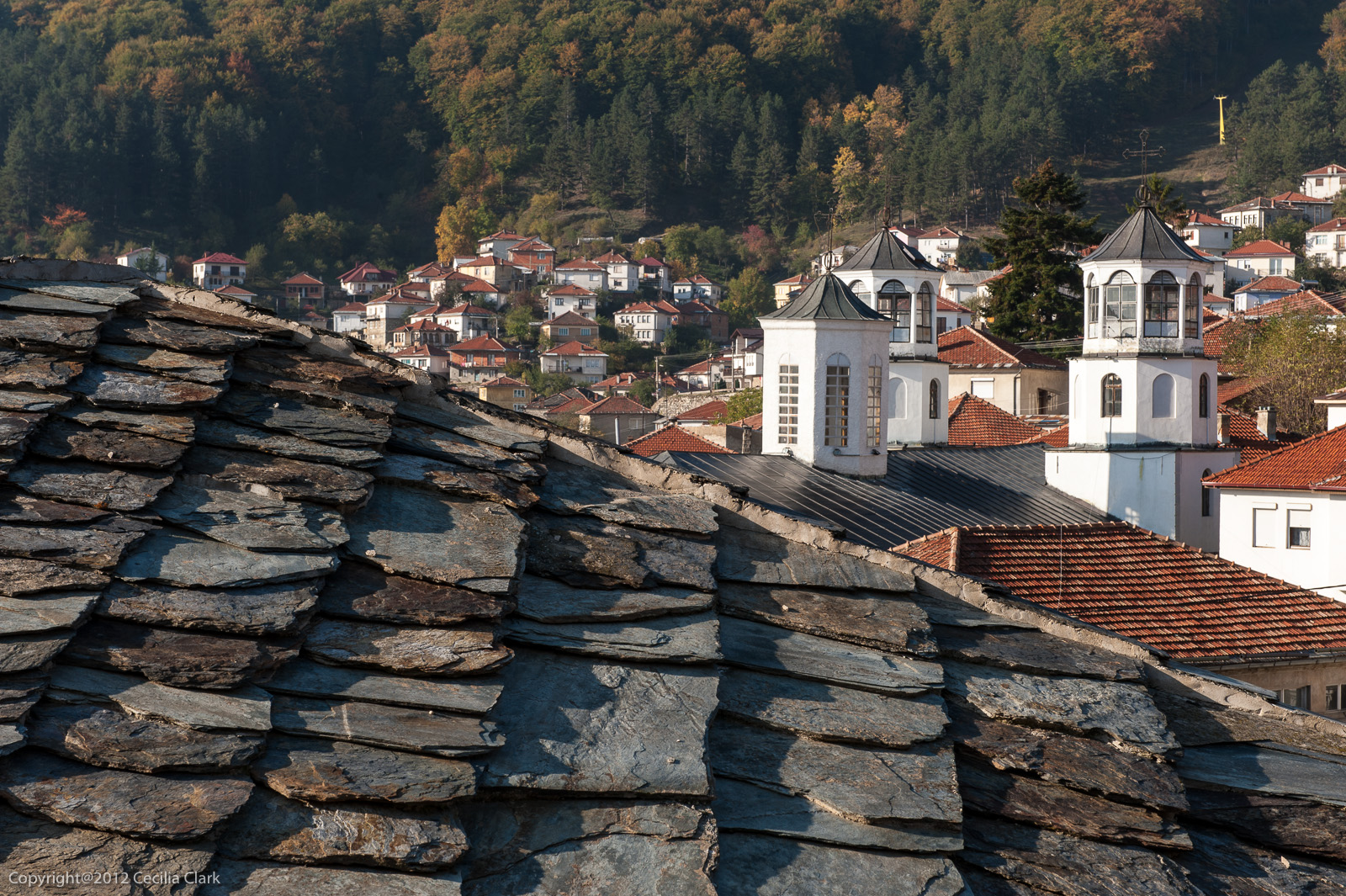
Traditional architecture in Kruševo
The guide at the Ilinden Uprising monument told us the Gallery Nikola Martinoski was open. This interesting gallery is in one of the houses of traditional architecture similar to the ones shown above. Martinoski was a painter, trained in Paris, who donated many of his fine works to Kruševo. The gallery also has several ethnographic rooms dedicated to early life in Kruševo.
View of Sveti Jovan from our balcony at Casa La Kola


A Cooper at the Barrel-making Shop in the Old Bazaar
Near the monument to the Ilinden Uprising is the Todor Proeski Memorial House. Todor known popularly as Toše was from Kruševo. In 2007 at 26 years old, he was killed in a car accident in Croatia. He was a singer who was very popular in the Balkans. I've heard him described as the Macedonian Elvis Presley in his popularity. The guide at the memorial house told us he was the best singer in all the world. The memorial house preserves everything from Toše' life. His toys, his sports equipment, his guitars, his clothing, his furnishings. Words to his songs are etched in glass throughout the memorial house. Also nearby is his grave covered by a tent that is filled with gifts left by fans that miss him and remember him.

Kruševo Lake is just beyond the Toše memorial house. The lake is small with a walking/bike trail around the perimeter. Many small fields of tobacco lay just across the bridge over the small dam that created the lake. One of the tobacco farmers invited us onto his land to see the process of picking, stringing, and drying tobacco leaves. He has two deci-hectars of land on which he grows tobacco. He said he grows a first class tobacco that will net him 4 Euro per kilo, and he will harvest and dry more than 400 kilos of tobacco this season.

Kruševo Lake is just beyond the Toše memorial house. The lake is small with a walking/bike trail around the perimeter. Many small fields of tobacco lay just across the bridge over the small dam that created the lake. One of the tobacco farmers invited us onto his land to see the process of picking, stringing, and drying tobacco leaves. He has two deci-hectars of land on which he grows tobacco. He said he grows a first class tobacco that will net him 4 Euro per kilo, and he will harvest and dry more than 400 kilos of tobacco this season.


A Field of Tobacco
Our last morning we returned to the lake because it was so lovely and photogenic.


