Showing posts with label Makedonija. Show all posts

Monday, January 7, 2013

Orthodox Christmas Day: January 7, 2013


Today is Orthodox Christmas in Macedonia.  We woke to a cloudy day that turned into morning snow flurries.  It is also Monday which means there is a Monday hike and an excuse to delay our packing one more day.

Dan and I joined two friends, Tereza and Tiesja, and drove to St. Nikita Monastery to hike through the mostly abandoned village of Chucer in Skopska Crna Gora located a few miles northwest of Skopje.  When we arrived there was still a light dusting of snow covering the ground and rooftops making the landscape look like a Christmas card.


We found that while many of the structures are indeed ruins and uninhabitable, there were a few homes still occupied.

 Resident of Chucer Village


The village across from Sveti Nikita

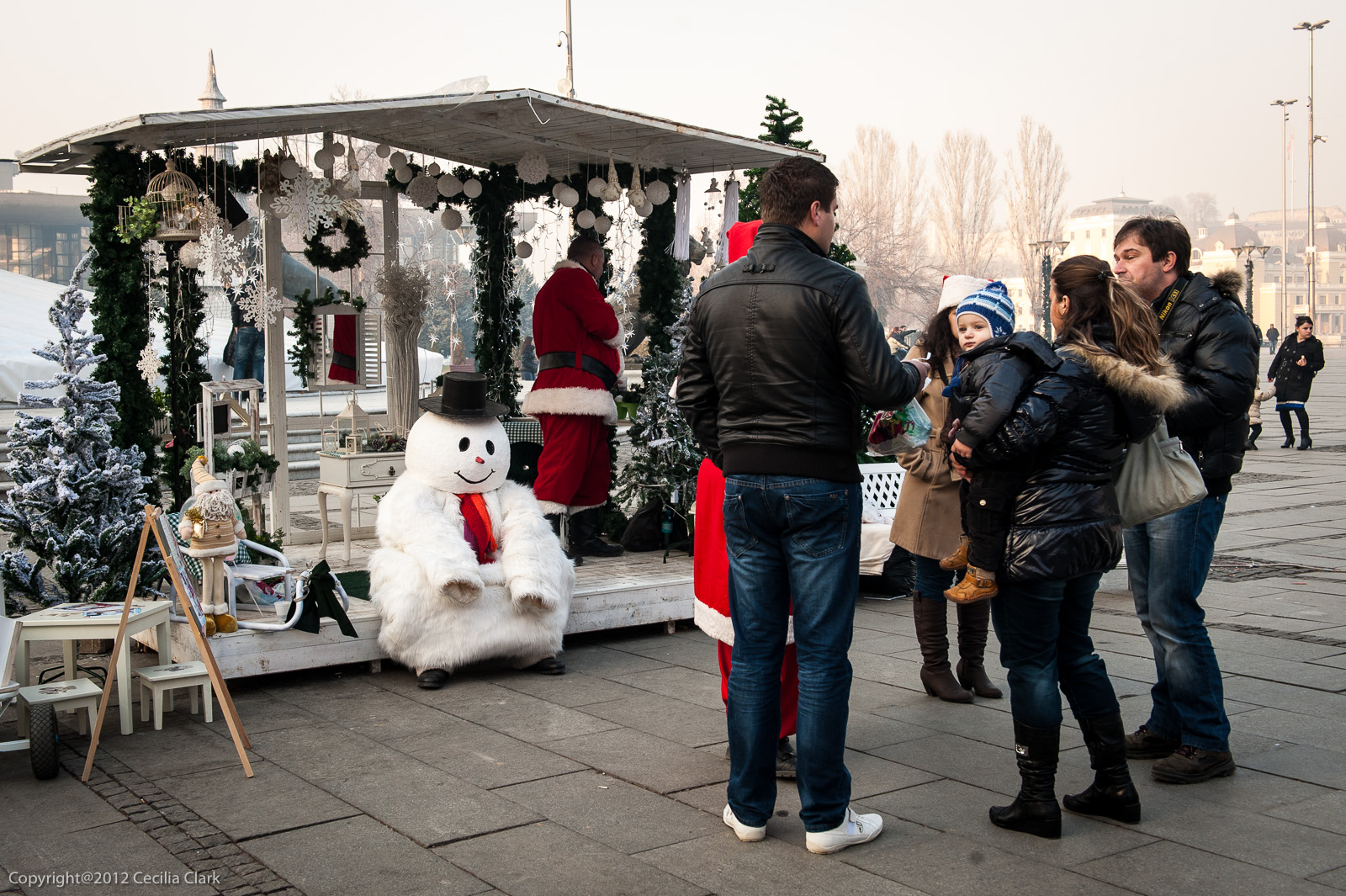
Santa Claus is not part of Christmas here and once New Year's Day was celebrated, the Santa gang quickly disappeared from the central square.  On the night of 5 January, with a nod to a pagan past,  bonfires were lit.  

We missed the bonfires, but we didn't miss the next tradition which occurs very early on Christmas Eve (called Badnik) day.  Just before 8:00 a.m. on 6 January, our doorbell rang and we could hear people singing outside the door.  This is kind of the Christmas version of Halloween.  The people on the other side of the door have bags into which you should put money or food.  Not being prepared for this event and having mostly emptied our cupboards and refrigerator of food in preparation for our departure, we did the best we could.  A few dinar coins here and food there.  

Another tradition for Christmas Day is bread (pogatcha) that is baked with a coin inside.  The one who takes the piece of bread with the coin will have luck the rest of the year.  

Tomorrow, 8 January, is our last full day in Macedonia.  We have arranged for a van to pick up us, our 8 suitcases, and Kali Cat and transport us to Sofia where we will spend the night in a hotel before leaving the Balkans on 10 January.  

While I look forward to going home, it is always so hard to say goodbye to those who have given me their friendship.  I will miss my friends, and many things about life in Macedonia.

Ciao Ciao Makedonija!

Monday, December 31, 2012

New Year's Celebration: December 31, 2012


Orthodox Christmas isn't until 7 January, however,  holiday lights and decorations began appearing in Skopje in early November.  Each week, something new has been added.  On our first day back in Macedonia, our Christmas Day, Dan and I were accosted by a gang of men hanging out at Macedonia Square.  They were wearing their gang colors--red and white with faux fur accents.  Curiously, they all wore hats, white wigs and long beards.


The members of this Santa-suited gang grabbed the hands of smiling children, tourists, and other unsuspecting foreigners and led them away.  The gang leader grabbed our hands and led us to a snowy little corner where we were held hostage by the gang's mascot until we agreed to have our photo taken.


The Santas, the trees, the lights are all related to the four days of celebration for the New Year.  New Year is a big thing in Macedonia.  My friends have told me that during the socialist period, celebrations related to religion were frowned upon so they were kept private.  The public celebration was for the New Year.  People get new clothes, go to many, many lunches, visit friends, and exchange presents for the New Year's celebration not for Christmas.  


Along the pedestrian street, tables have been set up to sell holiday greeting cards, New Year's hats and noisemakers, bottle rockets, and firecrackers.   Groups of children carelessly throw lit firecrackers on the streets and sidewalks.  For days now sporadic explosions have filled the air.


This afternoon, cafes blaring music were packed with people getting an early start on the celebration.  Tonight, there will be music in the square and fireworks afterward.  

 The decorated Makedonija pedestrian street

Happy New Year
Среќна Нова Година


Thursday, October 11, 2012

Ajvar Season in Macedonia: October 11, 2012

Today is a holiday; it is "People's Uprising Against Fascism Day."  This holiday caught us off guard with no plan on how to spend this day off.  After looking through our guidebook, we decided to take a taxi to Šuto Orizari.  Šuto Orizari or "Šuto" most people know it, is a Roma community.  There is a very large clothing market there that sells items at very low prices, but it is also a neighborhood. 

We walked along the main street passing the market by.  Eventually, we turned into the neighborhood.  The neighborhood is sprinkled with large homes that have been built by those families who have members working abroad.  These houses project wealth and success and returned remittances.  Between these mansion-like homes are much smaller, modest homes.  As we walked, we let our noses set the direction. The delicious smell of roasting peppers on this cool day perfumed the air.    

Autumn is the season of ajvar in Macedonia.  Ajvar is eaten all year long and it is its own food group in Macedonia.  It is served with meats and with white feta-like cheese.  It is used as a spread on thick slices of bread. 

At our first stop, we found peppers cooking on a metal platform over a wood fire.  The lady of the house vigilantly turned the peppers.  Once a batch of peppers are evenly grilled and the skins blistered, they are scooped into a plastic bag to sweat the skin of the peppers.  Once sweated, a group of family members begins the tedious work of separating the skin from the pepper.


After we watched for a while, this family directed us down and across the street to another ajvar-making group.  This was a larger group of friends and family peeling and seeding peppers.  In their recipe, they also add peeled tomatoes.  Some recipes include eggplant, as well. 


We did not stay long enough to observe the rest of the process. Ajvar is usually a two-day process.   Once the peppers are peeled, they are minced.  Because of the intensive hand work involved, this step is often mechanized with the use of a grinder to reduce the peppers to a mince.  A large, cauldron-like pot is placed over a wood fire and once oil covering the bottom of the pot is hot, the peppers and other ingredients are added.  As the peppers cook, the pot is stirred continually to keep the contents from burning.  Once cooked, ajvar is preserved in jars to be consumed all winter long, and there should be enough to last until the next ajvar season.

Here is an ingredient list from Macedonian Traditional Cookbook:

60 kilos red peppers (ajvar peppers)
10 kilos of eggplants
3.5 liters of oil
100 grams of sugar
salt to taste

Makes about 23 jars of ajvar

We enjoyed ourselves and I hope the Romas we met enjoyed meeting two Americans roaming their neighborhood and interested in how they live.  We caught a bus back to Skopje's center.

That was how we spent our "Uprising against Fascism" holiday.  The commemoration is for October 11, 1941; the day "the people of Macedonia began to organize and mount an armed insurrection against their Bulgarian and Italian occupiers with an attack on the local Axis-power headquarters in the city of Prilep...., Partisans staged a simultaneous uprising against the fascists in the city of Kumanovo. The October 11 rebellion launched the war for liberation from fascist occupation, which coincided with the rise of the communist movement in Macedonia."

Macedonian TV (MTB) station has a short YouTube MTB video giving the Macedonian version of the events of October 11, 1941.  The comments for this video have been disabled.  Why?  I'm guessing that not everyone agrees with this version of events.

Sunday, October 7, 2012

Weekend in Bitola and Prilep: October 4-7, 2012

We found ourselves in Bitola for the weekend because Dan was teaching a class of Macedonian lawyers. Bitola is lovely with many structures from the 18th, 19th, and early 20th-centuries.  Some say that if not for the massive earthquake in 1963, Skopje would look like this.  Anyway, the buildings along the pedestrian street are well preserved and give Bitola a quality and charm that is missing elsewhere in Macedonia.  


Bitola, like most cities in Macedonia, has an old Turkish town and bazaar dating back to the time when Macedonia was part of the larger Ottoman Macedonia.  


Pre-Balkan wars and WWII, Bitola was a flourishing city accommodating many religions within the small area of the present-day pedestrian street.  Then there were several mosques and a synagogue in the older, Turkish area and a catholic church, an orthodox church across the River Dragor in the 18th-century city. Today, the synagogue is gone as are the Jews.  A decade ago the Ottoman-era clock tower was topped with a cross.  In former times, Muslim imams looked to the time on the clock tower to guide their calls to prayer. Today, most of the mosques are non-functioning, remnants of history.

Interior of the Catholic Church 

A corner in the Old Turkish Bazaar (little Montmartre) area of Bitola


Strangely, even though the residents of Bitola, and indeed all of Macedonia chaffed under the yoke of Ottoman rule, half of the Bitola museum is a shrine to Ataturk.  Mustafa Kemel spent some of his military school years in Bitola and present-day Bitola honors that brief stay with a room dedicated to all things Ataturk.

After exhausting Bitola's offerings, I visited the nearby city of Prilep to see the tobacco harvest.  Twenty-two percent of the value of agricultural exports from Macedonia is from tobacco, and almost one third of the Macedonian state budget is financed by tobacco work.  Macedonia is ranked 30th in world tobacco production.  Prilep produces several small-leaf oriental tobaccos  It is the spice or seasoning when mixed with Virginia broadleaf tobacco.  Prilep tobacco is found in most of the world's top selling brands.

August, September, and October are the months that the leaves are handpicked from the tobacco plants.  As the leaves mature, they are stripped by hand from the plants.  Once the mature leaves are gathered, they are strung onto a 2-meter string and hung on wooded frames.  Drying racks are in front of houses and on empty lots.  During the harvest season, they are everywhere there is space.


There are large empty lots that are covered with tented drying racks.  Each tented structure has a family name written on it.  As the leaves dry and become golden, those strings are removed and new strings of green leaves are strung in their places.  


As cigarette makers move toward lighter, lower nicotine-type cigarettes, demand for Macedonia's oriental tobacco is declining. The World Health Organization (WHO) is pushing for regulations that will decrease cigarette consumption and smoking.  Tobacco growers all over the Balkans are opposed to these regulations.  Tobacco has been grown in Macedonia for over 100 years and a decline in this industry will cause thousands of small farmers to lose their only source of income.
  

Tuesday, October 2, 2012

Justice Delayed is Justice Denied: October 2, 2012

Dan and ЈУСТИНИЈАН I

The day before we left for our Balkan vacation, I received a call from an expat friend of mine.  She told me that she was being expelled as she had overstayed her visa.  The day before she had gone to the airport to catch a flight to Vienna; at the airport, the Macedonian Immigration Officer counted the days that she had been in Macedonia.  As with me, her days in Macedonia far exceed the rule of no more than 90 days within a 180-day period.  She missed that flight, and after interrogating her for a couple of hours and many calls by her to people in authority, Macedonian Immigration expelled her from the country ordering her to leave the very next day.

Before her call, I had become complacent in my efforts to become a legal resident in Macedonia.  After many, many exits and entries with no one noticing the total days that I have been here, I believed it unlikely that anyone would ever notice.

For our Balkan vacation, we crossed the border from Macedonia into Albania with no problems.  We returned two weeks later crossing from Kosovo into Macedonia.  Again, no problems.  But, spurred into action by my friend's experience, last week I assembled all the documents and their translations as specified last time by the woman at the Ministry of Internal Affairs (MOI).  Friday, I went to the MOI.  I arrived at 12:30 pm and discovered that the office is open only from 9 am to 12:30 pm.  Today, I returned with Dan who wanted to inquire about an extension of his resident visa which expires on November 14, 2012.

The same MOI woman took my package of documents and looked at Dan's resident visa card.  She said I cannot apply for a card unless the term of Dan's resident card is for one year.  She said she told us about that requirement the last time we were in.  She did not!

So, it is a Catch-22 for us/me.  We have just 3 months left to be in Macedonia, I have overstayed my tourist visa by 6 months, and I cannot get a card.

Dan has issues because his INCOMPETENT Macedonian lawyer proceeded as if Dan was an employee working in Macedonia and earning a salary here.  Dan is a volunteer and while his living expenses are reimbursed, he receives no money in Macedonia.  The Department of Labor wanted him to submit information showing that health care insurance, taxes, etc were being withheld from a Macedonian salary.  Since he is not an employee, he couldn't comply with the document request.

Also, last week I met our landlady once again at the Police Station to register my presence in Macedonia.  Because I don't have a resident card, I must report to the Police Station with my landlady within 48 hours of entrance into Macedonia.  This time, the officer was very bureaucratic even checking in his prior book for my last registration.  He also informed me that I was in violation because I had not advised the Police that I was leaving Macedonia within 24 hours of my departure.  I have been here since January 12, and this is the first time anyone has advised me of this departure notice requirement.

September 8 was Independence Day in Macedonia.  A new statue complex, which includes an eternal flame, was opened for unidentified Macedonian Fallen Heros.  The first statue is of Prometheus.  Prometheus caused quite a bit of trouble initially because he was buck naked.  Citing a complaint from unspecified women's organizations, the government directed the artist to cover the offending body part.  Now Prometheus wears a golden diaper.


Behind Prometheus, is a doorway to eternity leading to the eternal flame and beyond to the winged goddess symbolizing victory.  In the middle portion of the complex is a second doorway topped by 4 golden horses.  Above the doorway are the Latin words for immortality, freedom and justice.  The words are etched into the marble.  That is unfortunate because the Latin word for justice,  JUSTITA, is misspelled "JUSTICA."  The artist should have stuck with Cyrillic lettering as used on the statue of Justinian.  In that case, although he would not have been able to read his own name, Macedonians can.


Monday, July 23, 2012

Weekend in Mavrovo National Park: July 23, 2012


This is the image we woke to Saturday morning.  The photo is of the sun just peeking over the mountain that is behind Janče village.  We stayed in this village in the Hotel Tutto which is located just across a small ravine from the main village.  Janče is in Mavrovo National Park and it is located about 2-1/2 to 3 hours (120 km) southwest of Skopje.

Hotel Tutto was a wonderful, small bed & breakfast hotel (+389 (0) 42 470 999 or www.tutto.com.mk).  The meals prepared by the restaurant were the best we've had in Macedonia.  The first evening we had beefsteak (tender) with a wild mushroom sauce.  The second day we ordered a slow-cooked lamb that needs at least 5 hours advance notice to prepare.  We couldn't eat it all so we took the leftovers home with us.

The evening view from the restaurant terrace

Saturday, we hiked from the hotel through a wooded hillside about 3 km to the road.  From there we walked about 4 km along the road to Sveti Jovan Bigorski (St. John the Baptist) Monastery.  The monastery dates back to 1021, but the current version seems to be mostly from the 19th century.


19th century paintings on the outside of the church wall


 Fresco painting of St. Cyril and St. Metodius (creators of the Cyrillic alphabet)

Mountain spring water cooling watermelons

On the 7-kilometer walk back to Hotel Tutto we surprised a Balkan Chamois (wild goat).  He/she saw us and bounded up the mountain about 15 meters or so.  I saw only a flash of medium-brown flash as it moved.  When it stopped, I could see it through the trees with its facial striping and horns.

We also saw a small wild fire just below the hotel.  At the hotel, there was no power because the fire was threatening the village's power plant.  After a short, sweaty rest, we drove to the village of Rostuša to visit a nearby waterfall.  The village isn't far, but it is uphill.  The waterfall is only 1020 meters (1.2 km) from the road.  Unfortunately, Dan and I missed a small backwards fork in the trail and went many more kilometers out of our way and back until we found the right trail.  

The waterfall is in Rostuška River canyon.  Once the correct fork is found, the trail is lovely and shaded.  It runs along a small rivulet to various small cascades.  Duf Waterfall is at the trail's end.


This little canyon is cooler than any of the surrounding area.  There are picnic tables scattered along the river and it is quite photogenic.  After finding this waterfall so late in the day, Dan and I returned Sunday morning to take photographs with morning light.  It was beautiful.


Sunday, after the waterfall visit and breakfast, we continued southwest toward Debar to see the Sveti Gergi (St. George) monastery which is a nunnery.  


The only word I can think of to describe this small 19th century church is charming.  It is lovingly cared for by the nuns that live in the surrounding dormitory.  The inside frescos took 4 years to complete and they are extraordinary.  The monastery sits above the Debar Lake.

The only drawback to staying in Janče occurred during the wee hours of the morning. Both mornings at about 2:30 a.m. two drummers drumming walked through town for about one hour. Ramazan (Ramadan) began Friday, July 20, and the drummers were waking the village inhabitants before dawn so they could break their fast before daylight. Seems like a personal alarm clock would be sufficient. Ana, one of Hotel Tutto's employees, told us she lives in Rostuša (where the waterfall is located) and the drummers there drum for 3-4 hours every morning before dawn. On the second night in Janče I was prepared with ear plugs, closed windows, and a working air conditioner (the power had returned).

A few more photos at Flickr

Friday, July 20, 2012

At Last - A Legal Resident: July 20, 2012

All week I've been basking in the memory of my fabulous Galichnik weekend.  I haven't accomplished much this week except editing photos and writing my diary.  

Dan worked his last weekend and now he feels like a kid released from school for the summer break.  This afternoon we will go to Mount Bistra to a small village called Janče.  It is over the mountain from Galichnik.  We're hoping to do some hiking and just enjoy the mountain air for two days.  

Besides Dan being released from the "death march" of his creation, the other significant event was today's receipt of his official RESIDENT CARD.  We've been here for over 6 months.  Dan first began applying for this card more than 3 months ago.  The card he received today will expire mid-November 2012.  We don't leave Macedonia until January 2013.


Last night we saw another free concert as part of the Skopje Summer 2012 series.  This one was by a group from Denmark called Kynnes Kabale.  Some of the musicians originate from other countries, but all have now made their home in Denmark.  The group organizer and vocalist sang in Danish.  My ears aren't accustomed to listening to Danish in song or otherwise so it was a unique experience for me.  While the words were Danish, their music was not; it had an oriental sound with instruments to match.  One of the musicians played the saz which is a stringed instrument originating in Iran or Turkey.  The group surprised the crowd by singing a Macedonian folk song in Macedonian--a real crowd pleaser.


Sunday, July 15, 2012

Galichnik Wedding: July 15, 2012

The main event began last night at 7:00 pm with the decorating (tying a cross and flowers to it) of the flag and firing of a rifle three times.


Next, musicians were welcomed with rakija and candies by the bridegroom's family, and they began to play their drums and zurlas (a wind instrument). Accompanied by the musicians, the bridegroom's mother danced with a sieve on her head that is filled with bread and decorated with flowers.

A group of beautifully costumed women danced the lovely, graceful Nevestinskoto dance with the lead woman languidly waving a red handkerchief "made of tears" bidding her beloved to stay.  Then the men take the spotlight with the Teshkoto (hard) dance.  This dance begins slowly but the pace increases with the drummers' beat.  Each movement for both dances has a symbolic meaning and at once is both sad and joyful.


As darkness fell, an entourage of members of the bridegroom's family lit torches and walked to the bride's family house.  Once there, they escorted the bride back to fill her water jug from three different springs.  The water symbolizes the fluid life the bride hopes to have, and it is also the last time that the bride will fetch water for her father's home.


Farther back in the procession and behind the torch bearers is the bride.  She is the middle woman with a dark head scarf in the front row of the above photo.  She is carrying two water jugs that she will fill from three different springs.

That was the end of the wedding festivities for the first day.  The entertainment continued with a concert by Kalevala singing Macedonian folk songs.  Leaving the commotion and light of the square behind, we saw fireflies along the road and even the Milky Way was visible above us.  The clear, lovely voice of the singer followed us all the way back to the Hotel Neda. The drum and zurla musicians moved on to the restaurant and performed until 3:30 a.m.  

The wedding celebration resumed early this morning (about 8:00 a.m.) with a visit by the bridegroom and his relatives to the cemetery. At the cemetery, the bridegroom apologized for getting married without the presence of his ancestors. He invited his dead relatives to the wedding, and he left gifts and lit candles at the grave. The bridegroom is the tall man in the center front in the below images.


The second procession of the day headed by the bridegroom with the musicians bringing up the rear was to invite the godfather to the wedding. Then, there is the tradition of "shaving the bridegroom." This act symbolizes the groom's passage from boy to man and his separation from his mother.


Once shaved, the bridegroom changes from his dark pants into his white wedding trousers.  Everything he is wearing is made of a thick wool: pants, belt, shirt, jacket, and hat.

Around 10:00 a.m. a procession of the bridegroom's family led by the flag bearer proceeds to the bride's house bringing gifts for the bride.


At the bride's home several more customs are acted out.  Once finished with the formalities there, the bride was dressed in her wedding costume which consisted of 47 pieces of clothing and jewelry.  She is also wearing a large silver belt which was believed to protect the woman's womb.  The entire costume weighs in at 25 kilos (55 pounds).  She was covered with a white veil and placed on the groom's white horse to be escorted by her future in laws to the church.  The flag bearer again led this procession.  He was followed by a horse carrying the bride's dowry.  The two chests that make up the bride's dowry were covered by a sheep skin that has been dyed red.


As this procession winds through Galichnik it stops periodically so the bride can bow her head to the neighbors.

Once back at the church square, the bride and her bridegroom enter the church to have the marriage ceremony. While the actual marriage is taking place, the folk dancers entertained the crowd with both the Nevestinskoto and Teshkoto dances.


Once married, the couple are presented to the crowd and participate in the bride's dance.


The bride is the woman wearing a mostly gold dress with her white veil pulled back from her face. It was difficult to photograph her because she was quickly mobbed by photographers.


Afterward, I rejoined Olivera back at the Hotel Neda.  She told me that Aleksander had seated her in the VIP viewing stand.  The President of Macedonia did not stay at the Hotel Neda, but he eventually showed up for the celebration on the last day of the wedding.  When he arrived, he shook hands and greeted Olivera.  While Olivera was mingling with important Macedonians and four foreign ambassadors, I was following the many processions through Galichnik.

Back at the hotel we ate the traditional Galichnik meal of roasted lamb with Aleksander and Metodija while we waited for traffic to clear out of Galichnik.

More wedding photos can be seen at my Flickr page: Macedonia - Galichnik Wedding Celebration 2012