Showing posts with label Macedonia. Show all posts

Monday, January 7, 2013

Orthodox Christmas Day: January 7, 2013


Today is Orthodox Christmas in Macedonia.  We woke to a cloudy day that turned into morning snow flurries.  It is also Monday which means there is a Monday hike and an excuse to delay our packing one more day.

Dan and I joined two friends, Tereza and Tiesja, and drove to St. Nikita Monastery to hike through the mostly abandoned village of Chucer in Skopska Crna Gora located a few miles northwest of Skopje.  When we arrived there was still a light dusting of snow covering the ground and rooftops making the landscape look like a Christmas card.


We found that while many of the structures are indeed ruins and uninhabitable, there were a few homes still occupied.

 Resident of Chucer Village


The village across from Sveti Nikita

Santa Claus is not part of Christmas here and once New Year's Day was celebrated, the Santa gang quickly disappeared from the central square.  On the night of 5 January, with a nod to a pagan past,  bonfires were lit.  

We missed the bonfires, but we didn't miss the next tradition which occurs very early on Christmas Eve (called Badnik) day.  Just before 8:00 a.m. on 6 January, our doorbell rang and we could hear people singing outside the door.  This is kind of the Christmas version of Halloween.  The people on the other side of the door have bags into which you should put money or food.  Not being prepared for this event and having mostly emptied our cupboards and refrigerator of food in preparation for our departure, we did the best we could.  A few dinar coins here and food there.  

Another tradition for Christmas Day is bread (pogatcha) that is baked with a coin inside.  The one who takes the piece of bread with the coin will have luck the rest of the year.  

Tomorrow, 8 January, is our last full day in Macedonia.  We have arranged for a van to pick up us, our 8 suitcases, and Kali Cat and transport us to Sofia where we will spend the night in a hotel before leaving the Balkans on 10 January.  

While I look forward to going home, it is always so hard to say goodbye to those who have given me their friendship.  I will miss my friends, and many things about life in Macedonia.

Ciao Ciao Makedonija!

Monday, December 31, 2012

New Year's Celebration: December 31, 2012


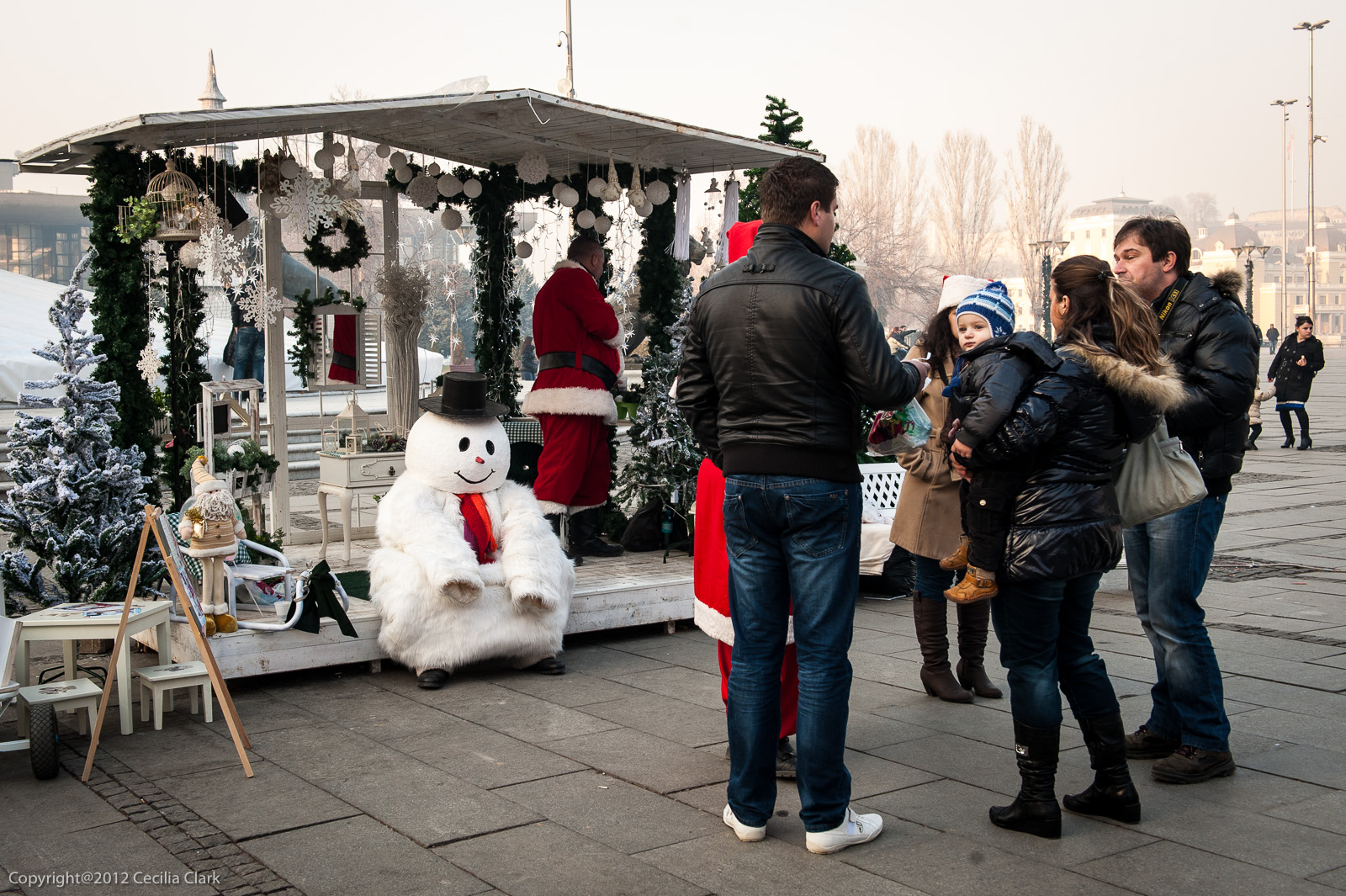
Orthodox Christmas isn't until 7 January, however,  holiday lights and decorations began appearing in Skopje in early November.  Each week, something new has been added.  On our first day back in Macedonia, our Christmas Day, Dan and I were accosted by a gang of men hanging out at Macedonia Square.  They were wearing their gang colors--red and white with faux fur accents.  Curiously, they all wore hats, white wigs and long beards.


The members of this Santa-suited gang grabbed the hands of smiling children, tourists, and other unsuspecting foreigners and led them away.  The gang leader grabbed our hands and led us to a snowy little corner where we were held hostage by the gang's mascot until we agreed to have our photo taken.


The Santas, the trees, the lights are all related to the four days of celebration for the New Year.  New Year is a big thing in Macedonia.  My friends have told me that during the socialist period, celebrations related to religion were frowned upon so they were kept private.  The public celebration was for the New Year.  People get new clothes, go to many, many lunches, visit friends, and exchange presents for the New Year's celebration not for Christmas.  


Along the pedestrian street, tables have been set up to sell holiday greeting cards, New Year's hats and noisemakers, bottle rockets, and firecrackers.   Groups of children carelessly throw lit firecrackers on the streets and sidewalks.  For days now sporadic explosions have filled the air.


This afternoon, cafes blaring music were packed with people getting an early start on the celebration.  Tonight, there will be music in the square and fireworks afterward.  

 The decorated Makedonija pedestrian street

Happy New Year
Среќна Нова Година


Thursday, November 22, 2012

Thanksgiving in Macedonia: November 22, 2012

Our Thanksgiving Day Hike

We started the day with a 3-hour hike on Mt. Vodno.  The fog was thick and constant even on the mountain.  After the hike, we visited a friend, Angel, because it was his birthday.  He gave us tickets to a festival of new Macedonian singers so we ended our Macedonian Thanksgiving Day with music from Macedonia.

In between we had dinner.  On Monday, I found a small frozen turkey that was raised in Sarajevo, Bosnia.   It was truly small weighing in at 7.2 lbs (3.3 kg), and it didn't take long to thaw.  Our ex-pat Thanksgiving dinner included the turkey, gravy, sweet potatoes,  mashed potatoes, and California wine.  I even managed to create a cranberry sauce using dried cranberries and jarred sour cherries.  

It was a very good day--a good Thanksgiving.

Thursday, October 11, 2012

Ajvar Season in Macedonia: October 11, 2012

Today is a holiday; it is "People's Uprising Against Fascism Day."  This holiday caught us off guard with no plan on how to spend this day off.  After looking through our guidebook, we decided to take a taxi to Šuto Orizari.  Šuto Orizari or "Šuto" most people know it, is a Roma community.  There is a very large clothing market there that sells items at very low prices, but it is also a neighborhood. 

We walked along the main street passing the market by.  Eventually, we turned into the neighborhood.  The neighborhood is sprinkled with large homes that have been built by those families who have members working abroad.  These houses project wealth and success and returned remittances.  Between these mansion-like homes are much smaller, modest homes.  As we walked, we let our noses set the direction. The delicious smell of roasting peppers on this cool day perfumed the air.    

Autumn is the season of ajvar in Macedonia.  Ajvar is eaten all year long and it is its own food group in Macedonia.  It is served with meats and with white feta-like cheese.  It is used as a spread on thick slices of bread. 

At our first stop, we found peppers cooking on a metal platform over a wood fire.  The lady of the house vigilantly turned the peppers.  Once a batch of peppers are evenly grilled and the skins blistered, they are scooped into a plastic bag to sweat the skin of the peppers.  Once sweated, a group of family members begins the tedious work of separating the skin from the pepper.


After we watched for a while, this family directed us down and across the street to another ajvar-making group.  This was a larger group of friends and family peeling and seeding peppers.  In their recipe, they also add peeled tomatoes.  Some recipes include eggplant, as well. 


We did not stay long enough to observe the rest of the process. Ajvar is usually a two-day process.   Once the peppers are peeled, they are minced.  Because of the intensive hand work involved, this step is often mechanized with the use of a grinder to reduce the peppers to a mince.  A large, cauldron-like pot is placed over a wood fire and once oil covering the bottom of the pot is hot, the peppers and other ingredients are added.  As the peppers cook, the pot is stirred continually to keep the contents from burning.  Once cooked, ajvar is preserved in jars to be consumed all winter long, and there should be enough to last until the next ajvar season.

Here is an ingredient list from Macedonian Traditional Cookbook:

60 kilos red peppers (ajvar peppers)
10 kilos of eggplants
3.5 liters of oil
100 grams of sugar
salt to taste

Makes about 23 jars of ajvar

We enjoyed ourselves and I hope the Romas we met enjoyed meeting two Americans roaming their neighborhood and interested in how they live.  We caught a bus back to Skopje's center.

That was how we spent our "Uprising against Fascism" holiday.  The commemoration is for October 11, 1941; the day "the people of Macedonia began to organize and mount an armed insurrection against their Bulgarian and Italian occupiers with an attack on the local Axis-power headquarters in the city of Prilep...., Partisans staged a simultaneous uprising against the fascists in the city of Kumanovo. The October 11 rebellion launched the war for liberation from fascist occupation, which coincided with the rise of the communist movement in Macedonia."

Macedonian TV (MTB) station has a short YouTube MTB video giving the Macedonian version of the events of October 11, 1941.  The comments for this video have been disabled.  Why?  I'm guessing that not everyone agrees with this version of events.

Sunday, October 7, 2012

Weekend in Bitola and Prilep: October 4-7, 2012

We found ourselves in Bitola for the weekend because Dan was teaching a class of Macedonian lawyers. Bitola is lovely with many structures from the 18th, 19th, and early 20th-centuries.  Some say that if not for the massive earthquake in 1963, Skopje would look like this.  Anyway, the buildings along the pedestrian street are well preserved and give Bitola a quality and charm that is missing elsewhere in Macedonia.  


Bitola, like most cities in Macedonia, has an old Turkish town and bazaar dating back to the time when Macedonia was part of the larger Ottoman Macedonia.  


Pre-Balkan wars and WWII, Bitola was a flourishing city accommodating many religions within the small area of the present-day pedestrian street.  Then there were several mosques and a synagogue in the older, Turkish area and a catholic church, an orthodox church across the River Dragor in the 18th-century city. Today, the synagogue is gone as are the Jews.  A decade ago the Ottoman-era clock tower was topped with a cross.  In former times, Muslim imams looked to the time on the clock tower to guide their calls to prayer. Today, most of the mosques are non-functioning, remnants of history.

Interior of the Catholic Church 

A corner in the Old Turkish Bazaar (little Montmartre) area of Bitola


Strangely, even though the residents of Bitola, and indeed all of Macedonia chaffed under the yoke of Ottoman rule, half of the Bitola museum is a shrine to Ataturk.  Mustafa Kemel spent some of his military school years in Bitola and present-day Bitola honors that brief stay with a room dedicated to all things Ataturk.

After exhausting Bitola's offerings, I visited the nearby city of Prilep to see the tobacco harvest.  Twenty-two percent of the value of agricultural exports from Macedonia is from tobacco, and almost one third of the Macedonian state budget is financed by tobacco work.  Macedonia is ranked 30th in world tobacco production.  Prilep produces several small-leaf oriental tobaccos  It is the spice or seasoning when mixed with Virginia broadleaf tobacco.  Prilep tobacco is found in most of the world's top selling brands.

August, September, and October are the months that the leaves are handpicked from the tobacco plants.  As the leaves mature, they are stripped by hand from the plants.  Once the mature leaves are gathered, they are strung onto a 2-meter string and hung on wooded frames.  Drying racks are in front of houses and on empty lots.  During the harvest season, they are everywhere there is space.


There are large empty lots that are covered with tented drying racks.  Each tented structure has a family name written on it.  As the leaves dry and become golden, those strings are removed and new strings of green leaves are strung in their places.  


As cigarette makers move toward lighter, lower nicotine-type cigarettes, demand for Macedonia's oriental tobacco is declining. The World Health Organization (WHO) is pushing for regulations that will decrease cigarette consumption and smoking.  Tobacco growers all over the Balkans are opposed to these regulations.  Tobacco has been grown in Macedonia for over 100 years and a decline in this industry will cause thousands of small farmers to lose their only source of income.
  

Saturday, August 4, 2012

Vacation - Days in Greece: Aug 1-3, 2012

Ancient Macedonia in the Former Yugoslav Republic of Macedonia (FYROM)

Dan and I took a short vacation through Northern Greece and into Albania.  Crossing the border into Greece from the country of Macedonia (where we live), a sign announces that you are in Greece and states, "Welcome to Macedonia".  The "Macedonia" in Greece is the ancient geographic Macedonia that at one time included the current country of Macedonia and beyond. Greeks refuse to acknowledge that there is a country called Macedonia.  In fact, Greeks will only refer to it with the acronym  "FYROM."  The citizens of the country we live in, Macedonia (or FYROM), refuse to call their country anything but Macedonia.  Renaming it to "North Macedonia" is just too much of a compromise for the vocal majority in Macedonia.  

Every evening for the last several weeks a handful of beautiful models have appeared under the Alexander the Great Statue.  They are dressed as ancient Macedonians and are there to pose with or for anyone who wants to take their photo.  

Once in Greece, our first stop was Pella.  This is where Alexander the Great and his father Philip II of Macedon were both born.  Their Pella is now an archaeological site surrounded by the roof tops of modern Pella.  The fabulous museum contains beautiful artifacts and several pebble mosaics of hunting scens and life in Ancient Pella.  The next image is of one of the mosaics visible at the archaeological site.


Our next stop was nearby Vergina.  Vergina is where Philip II of Macedon resided when he was not in Pella.  It is also where he died.  Some historians believe his wife, Olympia, and son, Alexander (the Great), killed Philip.  Anyway, Philip's tomb is in Vergina.  The tomb complex which is under a mound  was discovered undisturbed in the 20th century.  The tomb contained beautiful golden wreaths of oak leaves with acorns adorning urns containing the cremated remains of Philip II and others.  Philip's tomb contained three sets of magnificent armor given to him posthumously by his son Alexander.  The casket which held some of Philip's remains is decorated with the "Sun of Vergina".  This sun is a 16-rayed orb that the country of Macedonia wanted for their flag.  Needless to say, the Greeks were a little upset by such impertinence.  To cross into Greece from Macedonia, Greeks refuse to honor Macedonian passports.  However, so as not to lose any of the revenue from Macedonian tourists, Greeks will stamp a separate piece of paper in lieu of stamping the passport.


New statues in Skopje include Philip II of Macedon and Olympia holding Alexander as a child.  Both of these statues are still in progress.  These statues of the "loving" family of Alexander the Great are all located with a few meters of each other.  

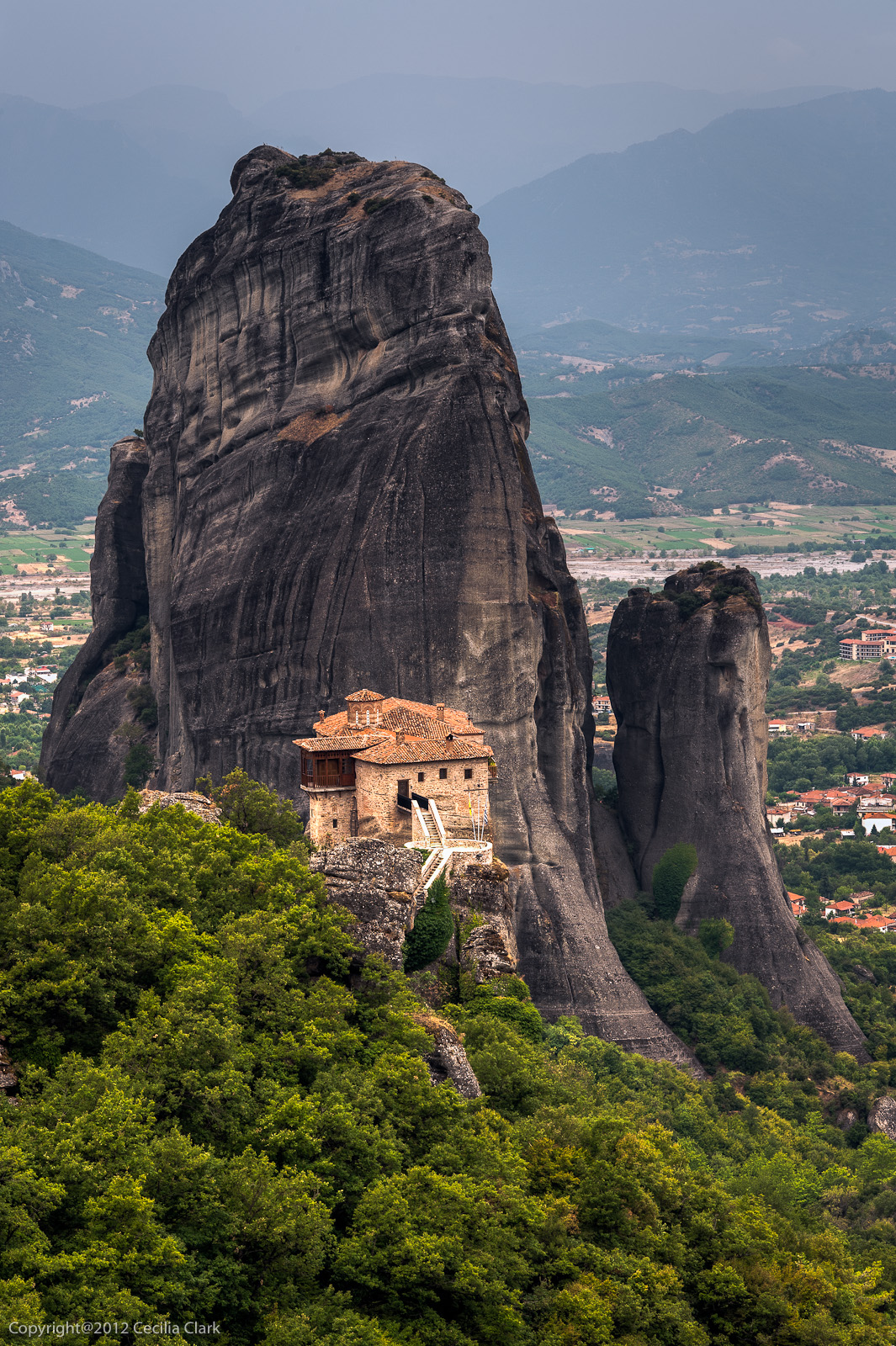
But, I digress.  Back in Greece we left the Grecian Macedonia and drove to Meteora.  Meteora is a group of knarled, twisted rock formations that rise about 300 meters (984 feet) above the plain and the town of Kalambaka.  Once an inland sea, when the water retreated, wind eroded the softer parts away leaving behind fabulous monoliths. 


Ascetic monks began arriving here in about the 10th-century.  By early 16th-century there were about 24 monasteries built atop these monoliths.  Six of those are still inhabited.  Now, the monasteries of Meteora feel like a religious Disneyland complete with entrance fees for each monastery except that no photographs are permitted of the interior spaces. Visitors are permitted to walk around/through a portion of each monastery.  Dan, a lifetime scofflaw, believed he was surreptitiously photographing the forbidden but his actions did not go unnoticed.  One of the monastery docents confronted Dan, made him delete each stolen photograph, and warned him that the police would be called if he did it again.  Of course, he did it again at a different monastery, but there they were less observant.  

Our first morning in Meteora we toured the five open monasteries which involved several steep climbs up the monoliths to reach each monastery.  

Varlaam Monastery with some of the stairs for the climb


Varlaam Monastery with Aylos Nikolaos Anapaphsas Monastery in the distant left

Roussanou Monastery

Roussanou Monastery, built in the 13th-century, is now a nunnery.  


Roussanou Monastery with a view of the plain beyond and the setting moon

Ayia Triada (Holy Trinity) Monastery


On the second morning, we visited the sixth monastery - Ayia Triada.  It was a very long climb up to this monastery.  All the monasteries have a winch system to bring up supplies.  This is the one used by Ayia Triada.  There is a large, iron hook hanging outside the image.


To get to Ayia Triada you must first descend from the road down a long, paved path to arrive at the steps for the climb.  Then, after ascending 140 steps, you have arrived at Ayia Triada.  The Bond film, For Your Eyes Only, was filmed at this monastery.  

These two guys dressed in Greek costumes (very Disneyland-like) were very enterprising.  They situated themselves on a panoramic overlook and charged tourists 1 Euro for the privilege of taking their photo.  


In Meteora we stayed at the Dellas Boutique Hotel in Kalambaka.  It is about a 10-minute drive up to the monasteries from here.  The hotel staff were extremely helpful and the buffet breakfast was packed with regional specialties like locally made feta and yogurt.  

Leaving Meteora behind, we drove to the city of Ioaninna, pronounced Yonina, near the Albanian border.  We stayed at a great B&B, Hotel Mir (hotel@hotel-mir.com), across the lake from Ioaninna.  This is the view of Ioaninna on the morning we left.  


It is a large city with a small Ottoman-era portion.  The innkeeper, Aris, wanted to make sure we could find the old city so he jumped on his motorcycle and we followed him into Ioaninna.  Once there we walked within the old walls, but the museum wasn't open and there wasn't much to see.  
Fethiye Mosque and the Tomb of Ali Pasha

Ferry on the Lake of Ionnina
Breakfast at the Hotel Mir was to die for.  Aris' wife served us regional Greek specialties like a cheese pie, fruits and vegetables from their garden, and homemade cakes.  Aris suggested we take a detour on our way to Albania to see the traditional Greek towns and bridges of the Zagori region.  He even caught up to us on his motorcycle to make sure we made the correct turn toward Zagori.  We went, but we needed much more time than 2-3 hours to explore it properly.  We photographed some of the 19th-century Ottoman built bridges and drove through a town, but then we had to be on our way.  It looks like a great area for hiking in cooler weather.


Next stop, Albania.

Monday, July 23, 2012

Weekend in Mavrovo National Park: July 23, 2012


This is the image we woke to Saturday morning.  The photo is of the sun just peeking over the mountain that is behind Janče village.  We stayed in this village in the Hotel Tutto which is located just across a small ravine from the main village.  Janče is in Mavrovo National Park and it is located about 2-1/2 to 3 hours (120 km) southwest of Skopje.

Hotel Tutto was a wonderful, small bed & breakfast hotel (+389 (0) 42 470 999 or www.tutto.com.mk).  The meals prepared by the restaurant were the best we've had in Macedonia.  The first evening we had beefsteak (tender) with a wild mushroom sauce.  The second day we ordered a slow-cooked lamb that needs at least 5 hours advance notice to prepare.  We couldn't eat it all so we took the leftovers home with us.

The evening view from the restaurant terrace

Saturday, we hiked from the hotel through a wooded hillside about 3 km to the road.  From there we walked about 4 km along the road to Sveti Jovan Bigorski (St. John the Baptist) Monastery.  The monastery dates back to 1021, but the current version seems to be mostly from the 19th century.


19th century paintings on the outside of the church wall


 Fresco painting of St. Cyril and St. Metodius (creators of the Cyrillic alphabet)

Mountain spring water cooling watermelons

On the 7-kilometer walk back to Hotel Tutto we surprised a Balkan Chamois (wild goat).  He/she saw us and bounded up the mountain about 15 meters or so.  I saw only a flash of medium-brown flash as it moved.  When it stopped, I could see it through the trees with its facial striping and horns.

We also saw a small wild fire just below the hotel.  At the hotel, there was no power because the fire was threatening the village's power plant.  After a short, sweaty rest, we drove to the village of Rostuša to visit a nearby waterfall.  The village isn't far, but it is uphill.  The waterfall is only 1020 meters (1.2 km) from the road.  Unfortunately, Dan and I missed a small backwards fork in the trail and went many more kilometers out of our way and back until we found the right trail.  

The waterfall is in Rostuška River canyon.  Once the correct fork is found, the trail is lovely and shaded.  It runs along a small rivulet to various small cascades.  Duf Waterfall is at the trail's end.


This little canyon is cooler than any of the surrounding area.  There are picnic tables scattered along the river and it is quite photogenic.  After finding this waterfall so late in the day, Dan and I returned Sunday morning to take photographs with morning light.  It was beautiful.


Sunday, after the waterfall visit and breakfast, we continued southwest toward Debar to see the Sveti Gergi (St. George) monastery which is a nunnery.  


The only word I can think of to describe this small 19th century church is charming.  It is lovingly cared for by the nuns that live in the surrounding dormitory.  The inside frescos took 4 years to complete and they are extraordinary.  The monastery sits above the Debar Lake.

The only drawback to staying in Janče occurred during the wee hours of the morning. Both mornings at about 2:30 a.m. two drummers drumming walked through town for about one hour. Ramazan (Ramadan) began Friday, July 20, and the drummers were waking the village inhabitants before dawn so they could break their fast before daylight. Seems like a personal alarm clock would be sufficient. Ana, one of Hotel Tutto's employees, told us she lives in Rostuša (where the waterfall is located) and the drummers there drum for 3-4 hours every morning before dawn. On the second night in Janče I was prepared with ear plugs, closed windows, and a working air conditioner (the power had returned).

A few more photos at Flickr