
Ancient Macedonia in the Former Yugoslav Republic of Macedonia (FYROM)
Dan and I took a short vacation through Northern Greece and into Albania. Crossing the border into Greece from the country of Macedonia (where we live), a sign announces that you are in Greece and states, "Welcome to Macedonia". The "Macedonia" in Greece is the ancient geographic Macedonia that at one time included the current country of Macedonia and beyond. Greeks refuse to acknowledge that there is a country called Macedonia. In fact, Greeks will only refer to it with the acronym "FYROM." The citizens of the country we live in, Macedonia (or FYROM), refuse to call their country anything but Macedonia. Renaming it to "North Macedonia" is just too much of a compromise for the vocal majority in Macedonia.
Every evening for the last several weeks a handful of beautiful models have appeared under the Alexander the Great Statue. They are dressed as ancient Macedonians and are there to pose with or for anyone who wants to take their photo.
Once in Greece, our first stop was Pella. This is where Alexander the Great and his father Philip II of Macedon were both born. Their Pella is now an archaeological site surrounded by the roof tops of modern Pella. The fabulous museum contains beautiful artifacts and several pebble mosaics of hunting scens and life in Ancient Pella. The next image is of one of the mosaics visible at the archaeological site.

Our next stop was nearby Vergina. Vergina is where Philip II of Macedon resided when he was not in Pella. It is also where he died. Some historians believe his wife, Olympia, and son, Alexander (the Great), killed Philip. Anyway, Philip's tomb is in Vergina. The tomb complex which is under a mound was discovered undisturbed in the 20th century. The tomb contained beautiful golden wreaths of oak leaves with acorns adorning urns containing the cremated remains of Philip II and others. Philip's tomb contained three sets of magnificent armor given to him posthumously by his son Alexander. The casket which held some of Philip's remains is decorated with the "Sun of Vergina". This sun is a 16-rayed orb that the country of Macedonia wanted for their flag. Needless to say, the Greeks were a little upset by such impertinence. To cross into Greece from Macedonia, Greeks refuse to honor Macedonian passports. However, so as not to lose any of the revenue from Macedonian tourists, Greeks will stamp a separate piece of paper in lieu of stamping the passport.


New statues in Skopje include Philip II of Macedon and Olympia holding Alexander as a child. Both of these statues are still in progress. These statues of the "loving" family of Alexander the Great are all located with a few meters of each other.
But, I digress. Back in Greece we left the Grecian Macedonia and drove to Meteora. Meteora is a group of knarled, twisted rock formations that rise about 300 meters (984 feet) above the plain and the town of Kalambaka. Once an inland sea, when the water retreated, wind eroded the softer parts away leaving behind fabulous monoliths.

Ascetic monks began arriving here in about the 10th-century. By early 16th-century there were about 24 monasteries built atop these monoliths. Six of those are still inhabited. Now, the monasteries of Meteora feel like a religious Disneyland complete with entrance fees for each monastery except that no photographs are permitted of the interior spaces. Visitors are permitted to walk around/through a portion of each monastery. Dan, a lifetime scofflaw, believed he was surreptitiously photographing the forbidden but his actions did not go unnoticed. One of the monastery docents confronted Dan, made him delete each stolen photograph, and warned him that the police would be called if he did it again. Of course, he did it again at a different monastery, but there they were less observant.
Our first morning in Meteora we toured the five open monasteries which involved several steep climbs up the monoliths to reach each monastery.

Varlaam Monastery with some of the stairs for the climb

Varlaam Monastery with Aylos Nikolaos Anapaphsas Monastery in the distant left
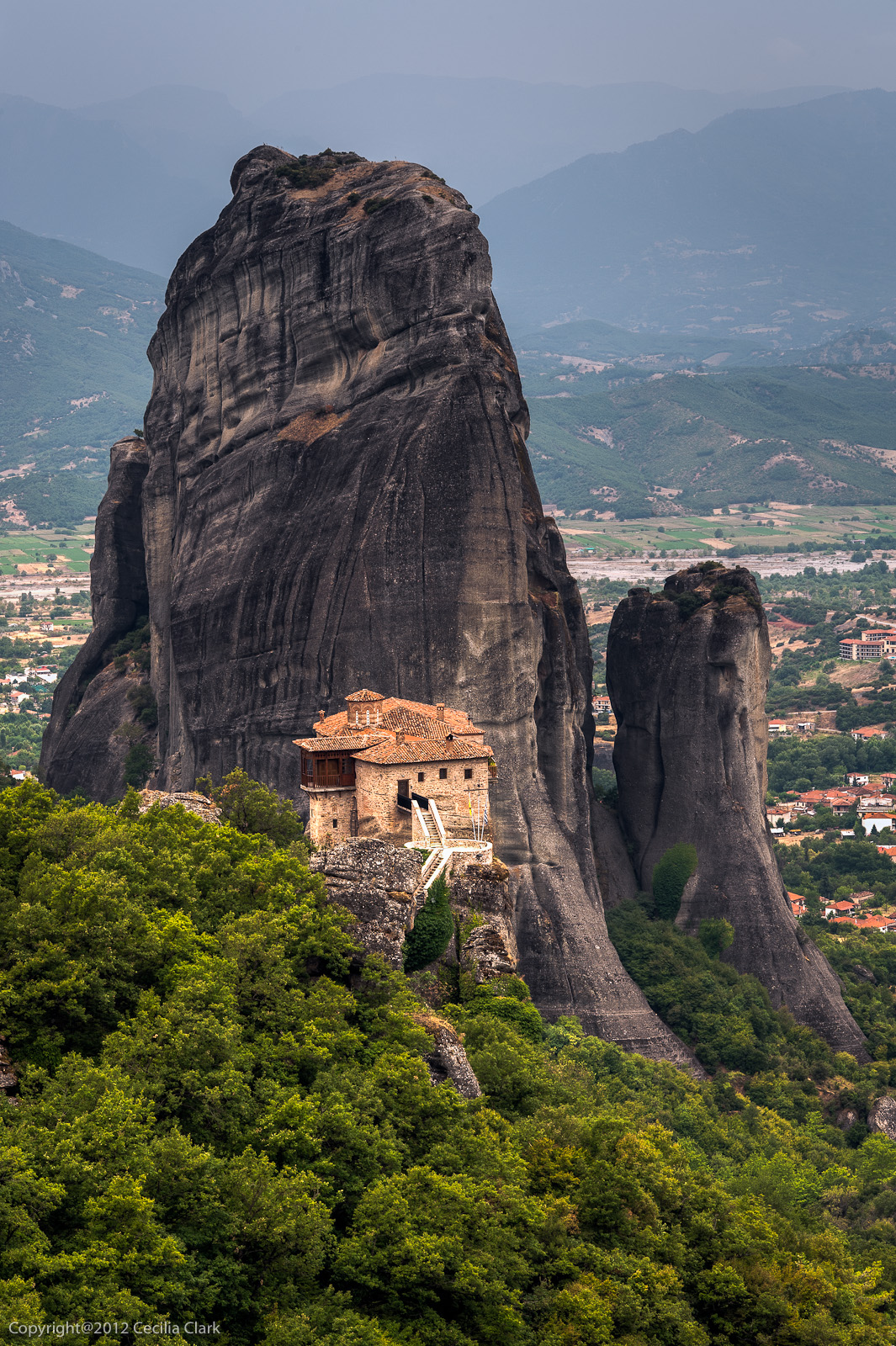
Roussanou Monastery
Roussanou Monastery, built in the 13th-century, is now a nunnery.

Roussanou Monastery with a view of the plain beyond and the setting moon

Ayia Triada (Holy Trinity) Monastery
On the second morning, we visited the sixth monastery - Ayia Triada. It was a very long climb up to this monastery. All the monasteries have a winch system to bring up supplies. This is the one used by Ayia Triada. There is a large, iron hook hanging outside the image.


To get to Ayia Triada you must first descend from the road down a long, paved path to arrive at the steps for the climb. Then, after ascending 140 steps, you have arrived at Ayia Triada. The Bond film, For Your Eyes Only, was filmed at this monastery.
These two guys dressed in Greek costumes (very Disneyland-like) were very enterprising. They situated themselves on a panoramic overlook and charged tourists 1 Euro for the privilege of taking their photo.

In Meteora we stayed at the Dellas Boutique Hotel in Kalambaka. It is about a 10-minute drive up to the monasteries from here. The hotel staff were extremely helpful and the buffet breakfast was packed with regional specialties like locally made feta and yogurt.
Leaving Meteora behind, we drove to the city of Ioaninna, pronounced Yonina, near the Albanian border. We stayed at a great B&B, Hotel Mir (hotel@hotel-mir.com), across the lake from Ioaninna. This is the view of Ioaninna on the morning we left.

It is a large city with a small Ottoman-era portion. The innkeeper, Aris, wanted to make sure we could find the old city so he jumped on his motorcycle and we followed him into Ioaninna. Once there we walked within the old walls, but the museum wasn't open and there wasn't much to see.
 |
| Fethiye Mosque and the Tomb of Ali Pasha |


 |
| Ferry on the Lake of Ionnina |


