Showing posts with label iconostasis. Show all posts

Saturday, September 1, 2012

Ečka, Serbia: August 29, 2012

We're in the village of Ečka located about 45 minutes north of Belgrade.  I'm told that about 5,000 people live in this village.  I've only seen about 100 residents and wonder where the other 4,900 are hiding.  The village was settled during Austrian rule.  The hotel we're staying in, Kaštel Ečka, was formerly center for aristocratic hunting parties.  The castle or manor house was built in 1820 in English style and violinist Franz Liszt played at the opening ceremony.  The castle and its outbuildings were mostly destroyed by the consequences of WWII.  The castle has undergone extensive renovations and additions and looks like an English Manor house.

We were given a suite which is quite lovely.  It has a very large bathroom with a jacuzzi tub and bedroom and living room areas.  Dan's Serbian colleague told him that it was the "best room" at the hotel.  It did not make a good first impression, though.  The light over the tub did not work so it was a black hole.  The room has two air conditioners--they don't work.  The room has two televisions--while they work, most of the channels are "snow".  The hotel list of satellite TV stations lists three English language stations.  The satellite does not appear to be connected to this room.

So, I almost had the driver return me and Kali Cat to Belgrade, but after a walk around the village, I decided to stay.

We discovered that there are at least 3 churches in Ečka.  The first images are of the Austrian Catholic church (perhaps also called the Kaštel church) that seems to be permanently closed.  It is situated right outside of the hotel grounds.  The main road through town jogs around the church and continues on.


The next church is the new Romanian church which was also closed when I attempted to visit it.  It is called "new" because it is newer than the older church formerly used by Romanians.  


Only the steeple of the new Romanian Church is visible in this photo.  The church is probably at least 200 years old.  

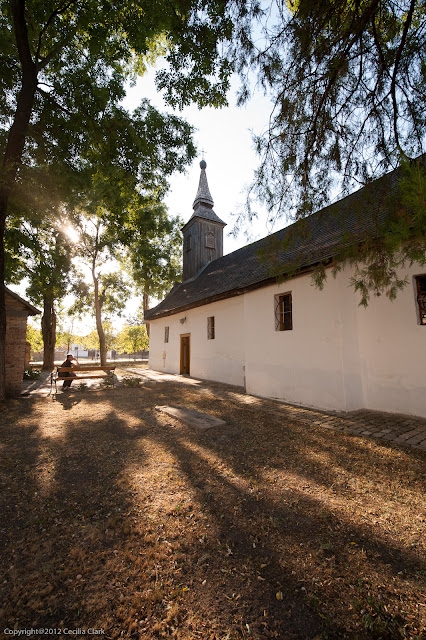
The third church was open--in fact, the door was wide open.  It is an Orthodox Church dedicated to St. Nicolas.  It was formerly shared by both the Serbian and Romanian residents of Ečka hence the reason why the yellow church is called the "new" Romanian church.  It is a beautiful building that dates back to about 1711.  The roof and steeple are made of wooden shakes and panels.  


Dan and I were inside taking photographs when the priest walked into the church.  He smiled, turned on the lights for us and indicated that we should turn them off when we were done.  How refreshing.    Some parishioners also stopped by.  One woman even dusted some of the table tops and tidied up the interior a little for me. 


Interior of the Church of St. Nicolas and its iconostasis.  This is the church's second iconostasis as the original structure and icons were replaced in about 1750.  


The above photo is of the "royal doors" of the iconostasis.  Only the priest and males are allowed behind these doors.  

The back portion of the church houses several icons.  Worshipers place offerings along the ledge.


This icon of the Virgin Mary and baby Jesus was part of the original 1711 iconostasis.  

  
After about an hour of taking photos, Dan left me to go to a meeting with his colleagues at the hotel.  I stayed and stayed.  I stayed until the cows came home--literally.  


After the cows, came children dressed in folklore costumes.  They were gathering for an International Children's Folklore Festival.  They gathered at the church and then paraded through the village toward the Cultural Center were they performed traditional dances.  


Dancers from Hungary

The festival has representative groups from Serbia, Slovakia, and Hungary.  

Despite my first impressions, Ečka rocks!

Saturday, April 14, 2012

Easter Weekend in Ohrid--Saturday

View from our room at Grebnos Stone House Apartments
Saturday in Ohrid began with sun and no wind but with ominous clouds threatening above.   We continued our walking tour of the old city seeing more noteworthy churches.  Most of the noteworthy churches for which visitors must pay an admission fee, feel cold and unused.  They are more like museums.

We visited St. Sophia a cathedral built in the 11th century.  During the Ottoman Empire, the church was converted into a mosque and then it became a warehouse.  In 1912 it was returned to it's status as a church.  In making it into a mosque the 11th-century frescos were covered with whitewash.  In the 20th century, the whitewash was carefully removed and the rare 11th-century frescos uncovered.  The interior is cavernous, austere, and cold.

Early 11th C Church of Sveti Sophia

Besides the church we went to on Good Friday evening, our favorite church was Sv. Jovan Kaneo.  The 13th C church sits on a rocky outcropping high above the lake.


We took photos from every angle and just enjoyed being there.  The sun was mostly out and the sky was fabulously photogenic.  The cliffside was covered with wildflowers and blooming mustard and two white swans swam by the churches coastline.  It was like a fairy tale.  Finally, we went inside the church.  I gave the church custodian a 1000 MKD bill for our 100 MKD each admission.  He gave me 700 MKD in change because that was all he had.  To make up for the short, he offered us candles, and he gave us a tour in French of the small interior.  Strangely, that while I'm not able to speak French, I can understand it pretty well.  At the end of the tour, he gave both of us a small glass of rakija.


Wood-carved Iconostasis at Sv. Jovan Kaneo
Custodian at Sv Jovan Kaneo
Our next stop was the museum housed in the 19th-century Robev house. The collection isn't very interesting, but the house is a beautiful example of 19th-century Macedonia architecture. The three-story wooden structure has been well renovated. The house, actually two houses side by side, was built by two brothers.  Each brother hired a different master builder and forbade the masters to confer with each other. The original structure was divided into two houses by a center wall. The third floor was not divided and both families shared this room. The ceiling of the third floor is embellished with a wood-carving in the shape of a medallion. The furnishings in the room are original and were also carved by master carvers in Ohrid.


Some of the shops in the new town sell decorative wood carvings, but we didn't see any pieces that compare to the skill of the 19th-century artisans who made the furnishings in the Robev house museum.
Studio of an Ohrid Woodcarver
The Muslim (Turkish and/or Albanian) neighborhood is at the far end of the Tourist Street.  


A few mosques and the outdoor market are in this neighborhood. Our guidebook didn't provide any details about the mosques so we picked an interesting looking one (Ali Pasha's Mosque) to enter. The structure is a round shape dome with a rather austere interior.  A group of kids were practicing music and singing inside during our visit.

Turkish Coffee Delivery
Our last church of the day was the renovated and heavily modified St. Kliment at Plaošnik. The renovation was completed in 2002 and the church is located next to the site of Kliment's monastery school from AD893.  Kliment or Clement is the patron saint of Ohrid. He arrived in Ohrid in the 9th century. The site chosen by Kliment for his monastery school/church was the site of a 5th century church. Kliment's monastery classes were taught in Slavic.

St. Kliment at Plaošnik


The area around the current church is the site of an extensive archaeological dig. This church also commands a beautiful view of the lake.  

A century after Kliment, Tsar Samoil moved the capital of his empire to Ohrid.  His fortress remains high above the old city of Ohrid.  


Yes, it's spring.


Friday, April 13, 2012

Easter Weekend in Ohrid--Good Friday

Orthodox Easter is observed over a 4-day period in Macedonia.  Friday, April 13, is Good Friday and Monday, April 16, is a holiday for Easter Sunday.  With a 4-day holiday it was the perfect time to see more of Macedonia.  We hired a cat sitter, rented a car, and on Friday we drove to Ohrid.  Ohrid is about 3-1/2 hours southwest of Skopje.   Unfortunately, the weather forecast was for rain the entire weekend.  About halfway, we stopped at "Мекиците од Стража" roadside cafe that serves all manner of fried or baked breads, called pies, stuffed with cheese, meat, or spinach made from a recipe developed in 1942.  The pies are many layers of pastry shaped into a rope and coiled into a circle. 

The town of Ohrid is described as the "Jerusalem of the Balkans" and pilgrims and vacationers from everywhere visit Ohrid during Easter.  Both the town and the lake are under UNESCO protection.  The lake is one of the oldest in the world and the deepest lake in the Balkans.  The town has roots back to Neolithic times and claims that it is the oldest continuous settlement of humans going back 7,000 years.  The lake sits on the Macedonia-Albania border.  

When we arrived in Ohrid, we quickly realized that we weren't going to be able to locate our hotel easily.  We were staying at the Grebnos Stone House Apartments within the walls of the old city.  We called our host and he took a taxi to our location in the new town and directed us back to the apartment.  

View of Ohrid's Old City on the Distant Hills
Once we were settled in our weekend apartment, we bundled up and walked around the old city.  At one time there were 365 churches, monasteries, and holy sites around the lake.  Now there are about 70.  We concentrated our visiting on the major attractions.  We saw Sveti Bogorodica Perivleptos (Church of the Holy Mother of God Most Glorious) a late 13th C church and its gallery of icons dating to the 13-14th C.  The exterior of the building is undergoing extensive renovation.  The interior is covered with the original frescos that were covered with the soot of centuries until uncovered in the late 1970s.  The diocese has a strangle hold on photos with no photos of any kind allowed.
Bell tower of Sveti Bogorodica Perivleptos in the distance
Just down the hill and past the upper gate we visited the 2000-year old Roman amphitheater.  It was buried for centuries until it was discovered in the early 20th century.  Now it is used for summer concerts.


We dined at Damar Restaurant across from the church of St. Sophia.  We were lured inside by the signs for lamb in a stove pot and pork cooked in honey.  Both were delicious.  After dinner we strolled down to the port and new town area.  Ohrid Lake, the jewel of Macedonia, looked more like an Alaskan lake rather than a Balkan lake.  It was so cloudy that the distant shore was not visible making the lake look more like an unbounded ocean.

Ohrid's Port
In the Ohrid's new town we could hear a church service beginning up the hill at the church of Sveti Bogorodica Kamenska.  The church is not old by Ohrid standards dating to 1832.  The exterior is not noteworthy, but the inside is fabulous.  This Good Friday evening, the church filled with worshipers holding lighted candles.  Many people lined up to pay their respect to a table of icons in the center of the church.  The top of the table (similar to a gazebo structure) was decorated with a variety of fresh ivy vines and spring flowers.  The table top was covered with a cloth that stretched to the floor.  Some of the worshippers went under the table crouching there for a few seconds and then exited the other side.  We've been told that this custom is peculiar to Macedonian Orthodoxy and the action symbolizes entering the tomb.  One person told us that it is believed that this action can bring about healing.   The priest and his young attendants sang passages and the congregation sang the response.  It was beautiful.

Dan with his stealth camera did take some photos, unobserved, during the service.

Good Friday Evening inside Sv Bogorodica Kamenska

We returned to the church on Saturday to take photos of the now empty church.  The flowers decorating the table and the church column were beginning to wilt, but the interior was still beautiful and obviously well loved.  The carpets and flooring were still covered with plastic sheeting to protect them from the extra foot traffic and wet shoes.

Wood-carved Iconostasis and Easter Gifts from Worshipers
The Table Symbolizing the Tomb of Christ
19th C Frescos in Sveti Bogorodica Kamenska